

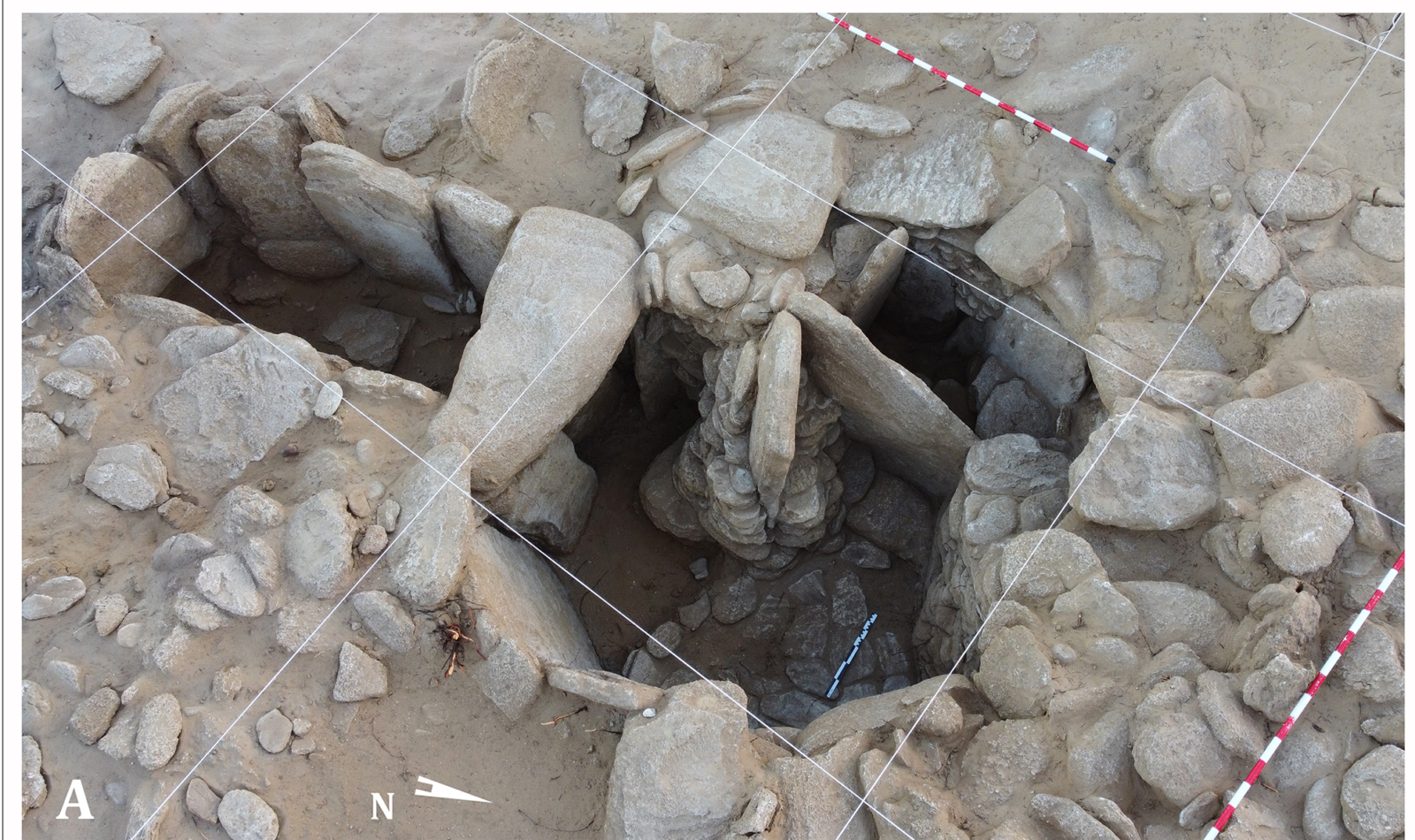
Archaeologists have uncovered two Bronze Age megalithic tombs beneath the dunes of Cape Trafalgar in Cádiz, Spain, containing gold earrings, silver beads, copper artefacts and an ivory comb that may have originated in Africa, offering new evidence of long-distance exchange networks across the Mediterranean and Atlantic worlds.
The Trafalgar necropolis, excavated in 2021 and 2022, consists of two collective tombs used between 1875 and 1625 BCE, with radiocarbon dating of 16 individuals placing the site among the latest known megalithic burial structures in southern Iberia, where individual graves had already become more common centuries earlier. The study, published in PLOS One on November 11th, 2026, by Eduardo Vijande-Vila of the University of Cádiz and colleagues, suggests that Bronze Age communities may have continued building and using large shared tombs well into the second millennium BCE, rather than simply reusing older Copper Age monuments.
Tomb I yielded two gold earrings, three silver beads, a piece of green mica, an ivory comb and two perforated shells, while Tomb II contained one earring, one copper arrowhead and one green mica bead, with the artefacts analysed using non-destructive techniques at the University of Cádiz laboratories. Almost none of the materials came from the local area, with the green beads made of chromium-containing mica that does not exist in the local geology, while the silver could have come from the southeast, the territory of El Argar, or the Iberian Pyrite Belt in the southwest, though isotope analysis would be needed to confirm the origin.
The ivory comb is considered more likely to be of African origin, though the researchers do not exclude an Asian source, with the gold, nearly 88 per cent pure with 12 per cent silver, resembling gold from other Iberian sites such as Valencina de la Concepción and more likely to be Iberian, though Africa cannot be ruled out. The presence of precious materials from distant regions suggests that the communities around Trafalgar may have had access to exchange networks that extended beyond their immediate surroundings, though the researchers caution that the presence of exotic materials alone does not prove direct maritime trade took place.
The tombs contained the remains of at least 13 people in Tomb I and at least seven in Tomb II, with the bones rearranged after the bodies had decomposed, except for the articulated skeleton of one young woman in Tomb I, whose radiocarbon dating indicates that her burial was the last to occur before the chamber was sealed. The site’s location at Cape Trafalgar, a landmark in a landscape dominated by the sea, suggests that the sea played a key role for these communities both economically, through trade routes, and ideologically, as a funerary landscape.
The discovery offers new perspectives on funerary practices during the Bronze Age, challenging the assumption that megalithic monuments were only reused rather than newly constructed during this period, with additional testing, including luminescence dating of when the sand and stones were last exposed to light, potentially revealing whether the tombs were reused or if the builders were among the last to build megalithic tombs in southern Iberia. The finding underscores the importance of continued archaeological research to uncover the full extent of ancient trade networks and cultural exchanges across the Mediterranean and Atlantic worlds.
Africa Presents is a Pan-African digital magazine and monthly publication covering politics, business, economy, culture, tech, and the stories shaping Africa and its diaspora. Visit africapresents.com and follow @AfricaPresents for daily coverage and monthly themed magazine editions.






Leave a comment