

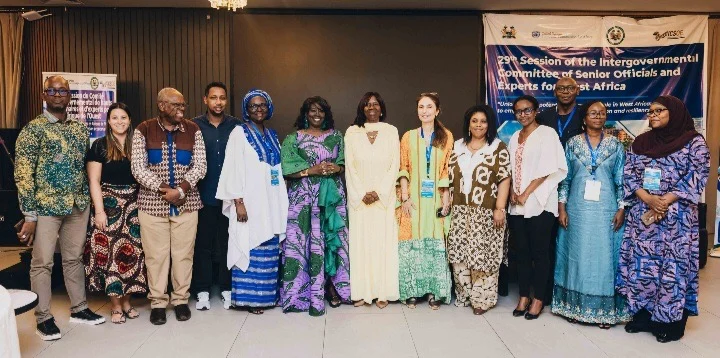
West African countries have adopted the Freetown Declaration, outlining a series of policy recommendations and concrete actions to unlock the potential of young people, expand productive employment and accelerate inclusive economic transformation across the subregion.The Declaration was adopted at the conclusion of the 29th Session of the Intergovernmental Committee of Senior Officials and Experts for West Africa (ICSOE for West Africa), held in Freetown from October 28th to the 30th, 2026, under the theme ‘Unlocking the potential of young people in West Africa: pathways to employment, economic transformation and resilience’. The session was co-hosted by the Government of Sierra Leone and the Subregional Office for West Africa of the United Nations Economic Commission for Africa (SRO-WA/ECA).
The Freetown Declaration calls on West African governments to strengthen institutional frameworks for youth development, align education and technical and vocational training with labour-market requirements, and increase investment in sectors with significant job-creation potential, including agriculture, agribusiness, livestock, mining, digital services and entrepreneurship. Member States are also encouraged to expand young people’s access to finance, productive assets, land and business development support, and to integrate youth employment priorities into national development plans, sectoral policies and public budgets, supported by effective monitoring frameworks.
The Declaration also calls for stronger attention to young people’s participation in the mining sector, sustainable tourism, sports and recreational activities, as well as improved prevention, treatment and rehabilitation services for drug and substance abuse, with the private sector encouraged to expand investment in productive activities, establish apprenticeship programmes in agricultural value chains and other growth sectors, and strengthen platforms such as the West African Business Linkage Platform (WABLP) to connect young entrepreneurs with markets, finance and mentorship.
ECA’s Director for West Africa, Ms Ngone Diop, underscored the scale of the region’s demographic opportunity, noting that 60.9 per cent of West Africa’s population was below 25 years in 2026, describing the region’s youthful population as a significant development opportunity that requires investment in relevant skills, productive employment, entrepreneurship and economic opportunities. “We must move beyond addressing youth employment as a stand-alone challenge and place it at the centre of our economic transformation strategies,” she said, urging governments to connect investment in people with the transformation of their economies.
The Declaration calls for the promotion of regional value chains, cross-border cooperation and youth participation in regional and continental markets under the African Continental Free Trade Area (AfCFTA), alongside improved labour-market statistics and the establishment of national baselines on public and private investment in youth, including profiles of young people not in education, employment or training (NEET). The Declaration also calls for the expansion of the Budgeting Sensitive to Demographic Dividend (BSDD) approach across West African countries that are ready for implementation, building on existing national experiences and supporting the identification and publication of public expenditure directed towards young people.
To ensure follow-up, the Declaration requests the Bureau of the Committee, with the SRO-WA/ECA’s support, to monitor implementation through a scorecard and report progress at the 30th session of the ICSOE for West Africa, with Member States also invited to present their progress on implementation of national commitments at that session. The recommendations will further be conveyed to the 2027 session of ECA’s Conference of African Ministers of Finance, Planning and Economic Development for review and decision.
The Freetown Declaration marks an important outcome of the 29th session, providing a framework for coordinated action by governments, ECA, development partners and the private sector to strengthen human capital, expand decent employment opportunities and harness the demographic dividend for West Africa’s structural transformation and resilience. The challenge now is to convert the commitments and partnerships announced at the Freetown meeting into measurable progress on the ground, with the scorecard mechanism providing a clear test of accountability.
Africa Presents is a Pan-African digital magazine and monthly publication covering politics, business, economy, culture, tech, and the stories shaping Africa and its diaspora. Visit africapresents.com and follow @AfricaPresents for daily coverage and monthly themed magazine editions.







Leave a comment