

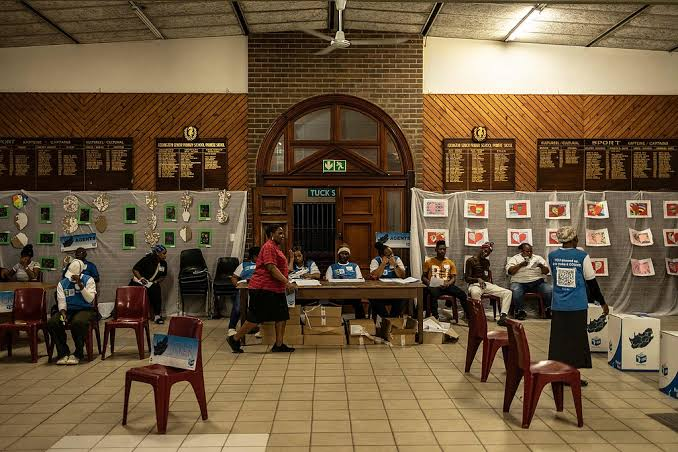
South Africa’s African National Congress (ANC) is on track for its worst-ever local election result, with early results showing the party at about 32 per cent of the vote after nearly half the ballots were counted in Wednesday’s municipal elections, down from 45.59 per cent in 2021.With 50 per cent of the vote counted, the ANC sat on 31.75 per cent of the national vote according to the Electoral Commission of South Africa, a drop of over 13 percentage points on its previous worst-ever showing, with the Democratic Alliance (DA) in second place at about 26 per cent. The results, if confirmed in the final tally, would represent a continuing erosion of the political monopoly the ANC has largely enjoyed since South Africa’s first democratic elections in 1994.
Voters cited anger over corruption, crime and failing public services, with “bread and butter” issues such as water, electricity, roads and sewage dominating the campaign and likely influencing voter choices more than political loyalties. The ANC, which has governed since 1994, fell below 50 per cent of the vote for the first time in the 2021 municipal elections, and suffered further losses at the 2024 national vote, securing just over 40 per cent and being forced into a power-sharing government with nine other parties.
The ANC’s decline in municipal elections has been particularly pronounced in Gauteng’s metros, with the DA leading in Johannesburg, Tshwane and Ekurhuleni in early results, while in KwaZulu-Natal the MK Party was leading with 33 per cent of the vote. In Johannesburg, South Africa’s economic hub, the DA attracted more than 30 per cent of voting intentions compared with slightly more than 20 per cent for the ANC, with the DA also holding a polling lead over the ANC in Tshwane and eThekwini.
The elections, contested by 546 political parties for control of 257 councils, including the country’s eight main city municipalities, 44 district councils and 205 local councils, saw the ANC emerge as the first party to secure control of municipalities, leading in 62 councils and controlling 21 with 1,483 seats at 69 per cent counting. The Patriotic Alliance (PA) was outperforming several bigger parties in the allocation of council seats, securing 26 seats despite attracting only 4.41 per cent of votes counted nationally, illustrating how the distribution of votes across municipalities can produce a different picture from national support percentages.
The ANC’s deputy secretary-general said the party was willing to ‘work with everyone’ in post-election coalitions, reflecting the reality that no single party is likely to secure an outright majority, with the ANC’s national support projected between 22 and 32 per cent by various polls ahead of the vote. The results will offer a key measure of voter sentiment ahead of the 2029 general election, with the ANC’s decline from nearly 70 per cent of the national vote in 2004 to 40.2 per cent in 2024 showing a consistent downward trend over two decades.
About 15.9 million of 29.2 million registered voters cast ballots, putting turnout at an estimated 54.5 per cent, up from 46 per cent in the pandemic-hit 2021 local elections, with Gauteng recording the highest voter turnout. The higher turnout did not translate into gains for the ANC, with the party’s vote share falling sharply even as more South Africans participated in the election.
Final results are expected on Sunday, with the ANC’s performance in the remaining outstanding municipalities potentially altering the national percentages and seat rankings, though the early picture is clear: the ANC holds the early advantage in councils and seats, but its national support has fallen substantially below its previous performance. The challenge now for the ANC is to arrest the decline before the 2029 general election, with the party’s internal dynamics and governance failures likely to remain central to the political debate.
Africa Presents is a Pan-African digital magazine and monthly publication covering politics, business, economy, culture, tech, and the stories shaping Africa and its diaspora. Visit africapresents.com and follow @AfricaPresents for daily coverage and monthly themed magazine editions.







Leave a comment