

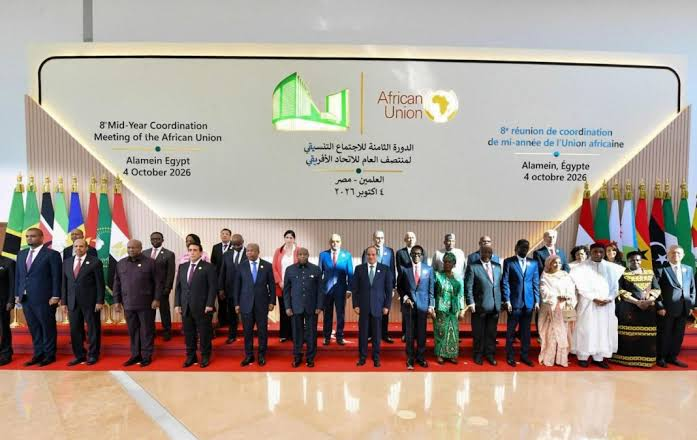
African leaders have renewed their commitment to accelerating continental integration, strengthening regional cooperation and advancing Agenda 2063 following the conclusion of the 8th African Union (AU) Mid-Year Coordination Meeting (MYCM) in El-Alamein, Egypt, on the 4th of October 2026.
Hosted by President Abdel Fattah El-Sisi, the meeting brought together Heads of State and Government, AU Commission leadership, Regional Economic Communities (RECs) and Regional Mechanisms to review progress on the continent’s integration agenda and chart a path from strategic aspirations to concrete, implementable projects.
AU Commission Chairperson Mahmoud Ali Youssouf called for a decisive shift from fragmented efforts to integrated action, stressing that the success of economic integration rests on a clear division of roles between the AU and the RECs, backed by adequate financing. He urged aggressive investment in cross-border roads, railways, energy grids, ports and digital networks to facilitate the movement of goods, services and people.
Évariste Ndayishimiye echoed the call, warning that trade agreements alone will not drive integration without domestic industrial capacity. “Africa must produce in Africa, transform in Africa, and add value to its resources in Africa,” he declared, calling for massive investments in cross-border infrastructure to connect the continent.
The meeting reviewed progress on the African Continental Free Trade Area (AfCFTA), welcoming advances in preferential trade arrangements while calling for further action to remove non-tariff barriers, improve trade facilitation, strengthen cross-border payment systems and promote regional value chains.
Leaders also examined the division of labour between the AfCFTA and the RECs, seeking to harmonise policies and avoid duplication. The goal is to unlock a truly integrated African market that can capitalise on the continent’s productive capacity, boost intra-African trade, support industrialisation and technology transfer, and create jobs.
AgenThe 8th MYCM reaffirmed that continental integration remains central to achieving Agenda 2063 and its Second Ten-Year Implementation Plan. Discussions covered the status of integration, the role of AUDA-NEPAD, and the need to strengthen institutional coordination and policy harmonisation between the AU and regional blocs.
Egyptian President El-Sisi framed coordination as “not an end” but a necessary shift from fragmented efforts to integrated ones, while also highlighting shared water security and sovereignty as pressing continental priorities. The meeting adopted a Declaration consolidating commitments to advancing integration, strengthening institutional coordination, and promoting sustainable development, peace and prosperity across Africa.
Beyond trade, leaders deliberated on accelerating infrastructure development and addressing peace and security challenges. SADC Chairperson and South African President Cyril Ramaphosa participated in the plenary, underscoring the importance of regional cooperation in tackling these cross-cutting issues.
The meeting’s outcomes signal a renewed push to convert the AU’s long-standing integration agenda into tangible results: better-connected markets, stronger industrial bases and more resilient economies. Whether this translates into faster implementation will depend on sustained political will, financing and follow-through by both continental institutions and member states.
Africa Presents is a Pan-African digital magazine and monthly publication covering politics, business, economy, culture, tech, and the stories shaping Africa and its diaspora. Visit africapresents.com and follow @AfricaPresents for daily coverage and monthly themed magazine editions.






Leave a comment