

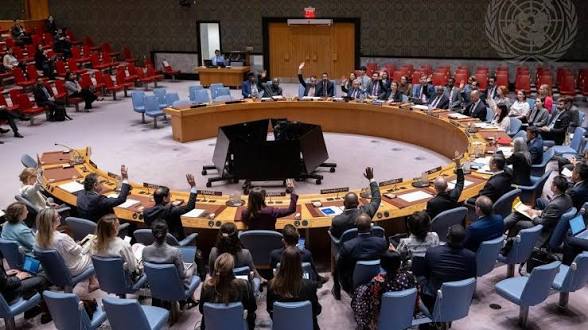
The United Nations Security Council has unanimously adopted a resolution extending sanctions against armed groups and individuals operating in the Central African Republic (CRA), renewing the measures until the 31st of July, 2027. The sanctions include asset freezes, travel bans, and restrictions on supplying weapons and military equipment to armed groups operating in the country.
Council members acknowledged Bangui’s gains in democratic governance, security, and state authority, but warned that armed groups and cross-border arms networks continue to threaten stability, particularly in border regions.
The resolution is the latest in a series of annual renewals that have maintained pressure on non-state armed actors in the CAR while progressively adjusting the sanctions architecture in favour of the central government. The UNSC lifted the arms embargo on the CAR government last year through Resolution 2745, but left in place the arms embargo on armed groups and associated individuals, alongside the targeted measures of asset freeze and travel ban against entities designated by the Sanctions Committee.
The CAR has been gripped by cycles of armed conflict since a coalition of rebel groups seized the capital Bangui in 2013. Despite a peace agreement in 2019 that was signed by the government and 14 armed groups, violence has persisted, with some factions continuing to operate outside the peace framework and others repeatedly violating its terms.
One Council member identified the structural challenge that sanctions alone cannot resolve: “If we don’t find the mechanisms which feed these groups, we run the risk of reproducing the cycle in which the armed groups are sanctioned, have their capacity temporarily reduced, and then rearm themselves through new supply circuits.” That observation captures the fundamental limitation of targeted sanctions in a country where porous borders, competing regional interests, and weak state reach outside the capital continue to provide armed groups with the space and resources they need to reconstitute after each round of international pressure.
The CAR government, with support from Russian Wagner Group forces, now renamed Africa Corps, and UN peacekeepers under the MINUSCA mission, has recaptured significant territory from rebel groups over the past three years. President Faustin-Archange Touadéra’s government has consolidated control over Bangui and expanded its reach into some provincial capitals that were previously contested.
What has not changed is the underlying dynamic in the country’s periphery. Armed groups continue to control key economic assets including mining sites and trade routes, using revenue from those activities to sustain their operations independently of whatever external supply routes the sanctions are designed to block. The panel of experts that monitors sanction implementation has repeatedly documented violations, including the diversion of weapons and the movement of sanctioned individuals, without the violations producing decisive consequences for the groups concerned.
The unanimous vote in the Security Council reflects broad consensus that maintaining the sanctions framework is preferable to removing it. It does not reflect consensus on what a durable resolution to the CAR’s security crisis would actually require, a question that remains as contested within the Council as it does on the ground in the country.
Africa Presents is a Pan-African digital magazine and monthly publication covering politics, business, economy, culture, tech, and the stories shaping Africa and its diaspora. Visit africapresents.com and follow @AfricaPresents for daily coverage and monthly themed magazine editions.






Leave a comment