

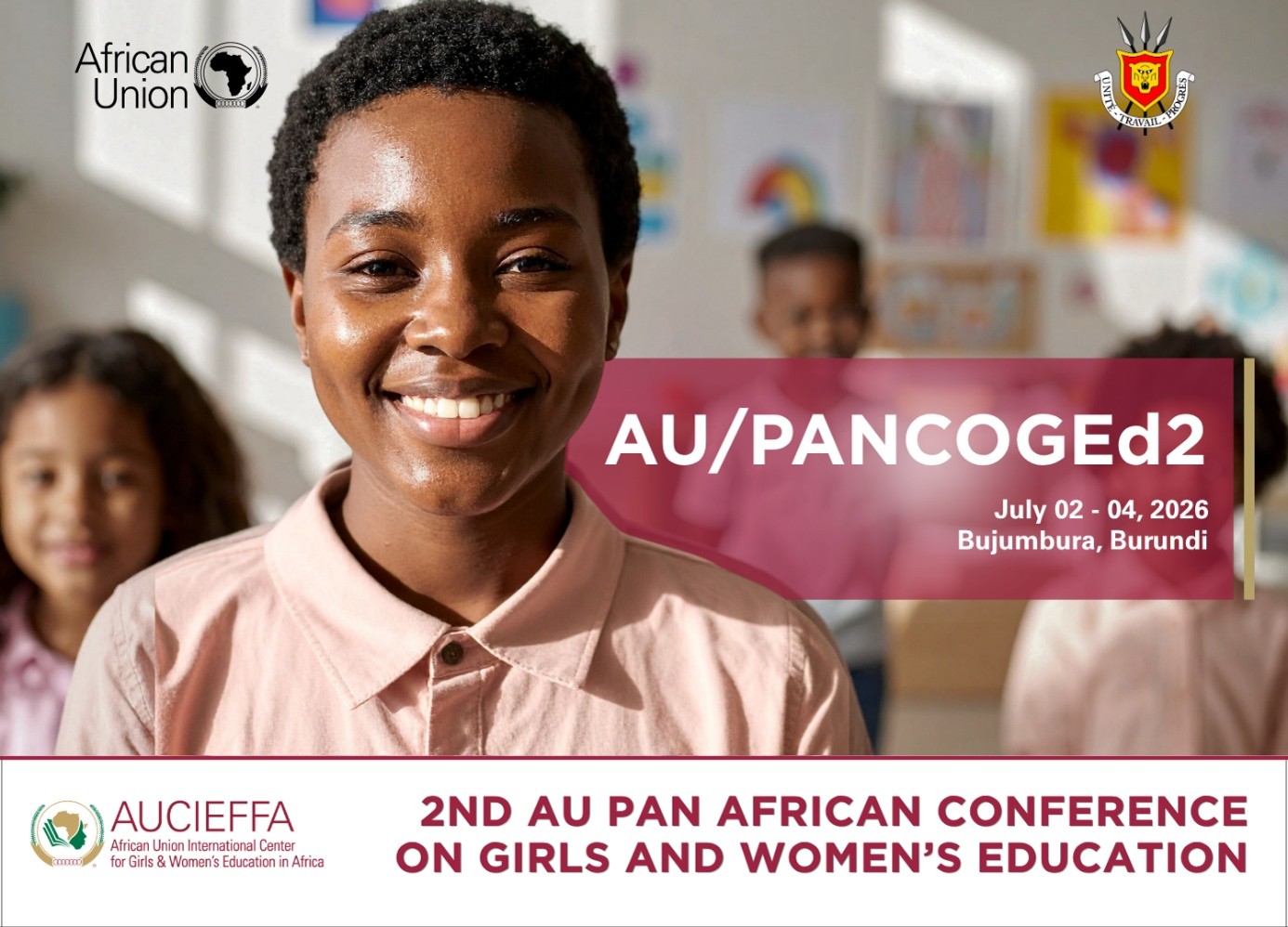
The African Union International Centre for Girls’ and Women’s Education in Africa has convened the 2nd Pan-African Conference on Girls’ and Women’s Education from the 2nd to the 4th of July 2026 in Bujumbura, Burundi, building on the landmark first edition held in Addis Ababa in July 2024. The three-day conference brings together ministers, policymakers, civil society, multilateral organisations, and education experts to accelerate collective action on one of the continent’s most consequential development challenges.
The first conference was officially opened at the African Union Commission Premises in Addis Ababa under the theme “Prioritizing Girls and Women’s Education: A Strategy for Increased access to inclusive, lifelong, quality, and relevant learning in Africa,” drawing close to 500 in-person and 300 online participants. Participants called for generating gender-disaggregated data, promoting women’s leadership in education, closing the gender gap in digital literacy, and adopting the #AfricaEducatesHer campaign.
The Numbers That Make the Case
The economic impact of failing to invest in girls’ education is severe. UNESCO estimates show that by 2030, the annual private costs of children leaving school early and having less than basic skills in sub-Saharan Africa will represent 19 percent and 26 percent of the region’s GDP respectively. Economic losses due to girls not learning amount to $210 billion for girls and $190 billion for boys.
These are not abstract projections. They represent children who leave school without the skills to participate in a rapidly changing economy, families trapped in poverty cycles, and a continent that cannot meet its Agenda 2063 development targets while leaving half its population behind in the classroom.
What the 2026 Work Has Looked Like So Far
In March 2026, AU CIEFFA, in collaboration with the Forum for African Women Educationalists, convened a high-level side event at the 70th Session of the Commission on the Status of Women in New York, titled “Inclusive and Equitable Legislative Systems and Policy Reform to Accelerate the Status of Girls and Women’s Education in Africa.” The event brought together policymakers, parliamentarians, AU delegates, and civil society to examine how legislative reforms can accelerate gender equality in education across the continent.
Key calls from the New York event included harmonising national legal frameworks to align with regional and international commitments on girls’ rights, eliminating discriminatory laws including those that enable child marriage, and securing sustainable financing for girls’ education through gender-responsive budgeting.
What Needs to Change
Africa’s tertiary enrolment rate sits at around 9 percent, far below the global average of 38 percent, and girls remain disproportionately excluded at every level of education. Among the UNESCO Prize for Girls’ and Women’s Education laureates showcased at the first conference were the Girls Livelihood and Mentorship Initiative from Tanzania and Girl MOVE Academy from Mozambique, which has changed the lives of over 5,000 adolescent girls and young women since 2014. These models demonstrate that solutions exist. The challenge is scaling them from individual programmes to continental policy.
The Bujumbura conference arrives at a moment when foreign aid for education is contracting sharply, making the push for domestic financing and legislative reform more urgent than ever. Africa cannot educate its girls on the promise of external goodwill. It requires its own governments to commit, fund, and follow through.
Africa Presents is a Pan-African digital magazine and monthly publication covering politics, business, economy, culture, tech, and the stories shaping Africa and its diaspora. Visit africapresents.com and follow @AfricaPresents for daily coverage and monthly themed magazine editions.







Leave a comment