

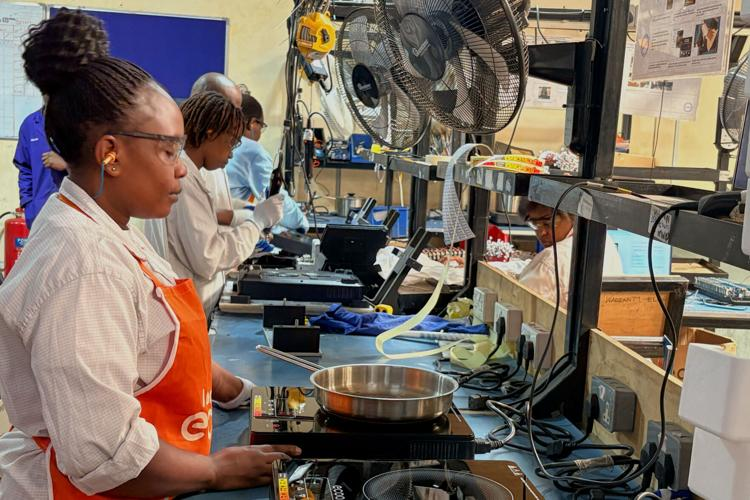
Carbon credit financing is emerging as Africa’s most important tool for expanding access to clean cooking, with companies and governments increasingly relying on future emissions reductions to fund stoves, fuels and distribution networks across the continent.
Clean cooking firms say they are using carbon finance to make cleaner technologies affordable for households that would otherwise continue to rely on charcoal, firewood and kerosene. Under this model, investors provide upfront capital that subsidises the retail price of stoves, while companies monetise the resulting emission reductions by selling carbon credits on international markets.
Every year, millions of tonnes of carbon dioxide are released when households burn wood and charcoal for cooking. Switching to more efficient biomass stoves, biogas systems or electric cookers reduces fuel use and cuts those emissions. Those verified reductions can be converted into carbon credits, each representing one tonne of CO₂ avoided, which are then sold to corporations, airlines and other buyers seeking to offset their own emissions.
The revenue from credit sales allows companies to recover part of their costs and offer stoves at lower prices or on pay-as-you-go plans. In practice, many households do not buy cleaner stoves because of climate concerns but because carbon-financed subsidies and flexible payment terms make them cheaper than traditional options.
Clean cooking projects have several features that make them appealing in a carbon market that is increasingly focused on integrity and measurable impact. Unlike forestry projects, cookstove credits are based on avoided emissions rather than stored carbon, so they do not carry the same risks of reversal from fires or illegal logging. Emissions reductions can be measured through fuel consumption data, smart meters and standardised monitoring protocols, which simplifies verification.
At the same time, clean cooking delivers strong co-benefits beyond climate mitigation. It reduces indoor air pollution, which is responsible for millions of premature deaths each year, mostly among women and children. It lowers the time and cost of collecting fuel, improves safety and can support local manufacturing and jobs. These social and health gains are increasingly valued by buyers of high-integrity credits.
Recent market analysis shows household activities, particularly cookstoves and domestic biogas, have become the largest source of newly issued carbon credits. Clean cooking projects now account for a significant share of retired credits, and demand is growing as corporate climate policies evolve to recognise high-quality offsets as a complement to direct emission.
Across Africa, governments are formalising their participation in international carbon markets and explicitly backing clean cooking as a priority sector. Rwanda has authorised 1.77 million tonnes of CO₂ equivalent from an improved cookstove project, opening the door to eligibility under the aviation sector’s CORSIA scheme. Ghana’s Article 6 pipeline is heavily concentrated in clean cooking, which represents about 58% of potential volume. Kenya has built structured authorisation frameworks and capped transfers at 10 million tonnes through 2030, while Uganda and other countries are aligning their rules with global standards.
In West Africa, ECOWAS is working on a regional carbon market platform that could help member states generate and trade credits under harmonised rules. Analysts say clean cooking is one of the most promising project categories for the region, capable of attracting climate finance while delivering tangible health and environmental benefits at scale.
Recent deals illustrate the momentum. In August 2026, Togo signed an $8.5 million financing agreement with three carbon market firms to deploy improved cookstoves nationwide by 2032, with funding expected from U.S. investment banks. BURN, a major clean cooking company, has distributed more than 166,000 stoves in Malawi alone and is authorised to generate 3.5 million carbon credits from its activities there. The company recently announced it had sold 1 million CCP-labelled credits, a mark of high integrity under the Integrity Council for the Voluntary Carbon Market.
Despite the optimism, carbon finance for clean cooking is not without controversy. The voluntary carbon market has faced criticism over questions about the credibility of some projects, including concerns about baselines, additionality and whether claimed emissions reductions are real and durable. New standards and methodologies are tightening requirements, phasing out older tools and pushing for more conservative estimates of fuel savings. Some projected emission reductions may no longer be claimable under stricter rules.
Countries are also introducing controls on how many credits can be transferred internationally under Article 6 of the Paris Agreement, requiring corresponding adjustments to avoid double counting. This means governments must balance attracting investment with retaining enough credits to meet their own climate targets. Developers say these changes do not make cookstoves the wrong choice, but they do make low-quality projects unsustainable.
For many African households, the shift to clean cooking is happening not because of abstract climate goals but because carbon-financed stoves are now cheaper and more accessible. Companies are betting that, if governed well, carbon markets can become a durable source of capital to scale these solutions across the continent.
As rules converge and buyers demand higher integrity, the focus is shifting from quantity to quality. Projects that can demonstrate robust monitoring, conservative accounting and real-world impact are likely to attract premium prices and long-term investment. In that sense, carbon credit financing is not just funding stoves; it is helping to shape a more disciplined, results-driven clean cooking sector in Africa.
Africa Presents is a Pan-African digital magazine and monthly publication covering politics, business, economy, culture, tech, and the stories shaping Africa and its diaspora. Visit africapresents.com and follow @AfricaPresents for daily coverage and monthly themed magazine editions.







Leave a comment