

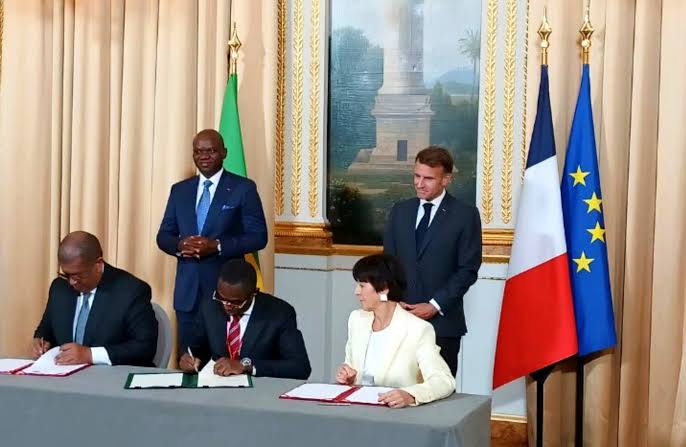
Gabonese President Brice Clotaire Oligui Nguema signed three strategic agreements during his state visit to France on Monday 20th of July, with the headline achievement being an initial memorandum of understanding between French mining group Eramet and the Gabonese government on the local processing of manganese, the mineral that forms the backbone of Gabon’s resource economy.
The MOU lays out plans to process up to 700 kilotons, or 700,000 tonnes, of manganese ore inside Gabon annually by the end of 2031, a significant step toward what President Oligui Nguema has made a defining economic priority of his administration. French President Emmanuel Macron received Oligui Nguema at the Élysée Palace for discussions described by both sides as a new phase in Franco-Gabonese cooperation “focused on concrete results that are tangible for the people.”
The MOU, signed in the presence of both presidents, sets out a joint industrial roadmap with three distinct options. The most immediate involves the construction of a manganese oxide production plant near Libreville, potentially operational before the end of 2028. The second covers the renovation of the Moanda metallurgical complex, described by Eramet as the only active mineral processing site in Gabon and Central Africa, with modernised installations expected to be operational by the end of 2029. The third and most ambitious scenario involves the construction of an entirely new manganese alloy production plant by 2031.
The agreements will help “generate greater added value within the country, support its industrialisation and boost the competitiveness of the national economy,” President Oligui Nguema’s office said.
The policy echoes a growing pattern across Africa, with Guinea, Zimbabwe, and Tanzania also moving to restrict raw material exports and encourage domestic refining, in what has become one of the continent’s most consequential economic sovereignty debates.
Among other things, the state visit also covered the future of French military basing arrangements in Gabon and the land title to a former French army base in Libreville, as France continues to reshape its military footprint across the continent. Additional agreements were signed on the water and energy sectors, with further manganese-related commitments expected as the three-day visit continued.
For Gabon, the Paris visit marks a meaningful step in converting its mineral wealth from a raw export commodity into domestic industrial capacity. Whether the 2029 deadline holds and the processing targets are met will be the measure of whether the MOU produces what Libreville has been seeking: not just a stronger partnership with France, but a more sovereign relationship with its own resources.
Africa Presents is a Pan-African digital magazine and monthly publication covering politics, business, economy, culture, tech, and the stories shaping Africa and its diaspora. Visit africapresents.com and follow @AfricaPresents for daily coverage and monthly themed magazine editions.




Leave a comment