

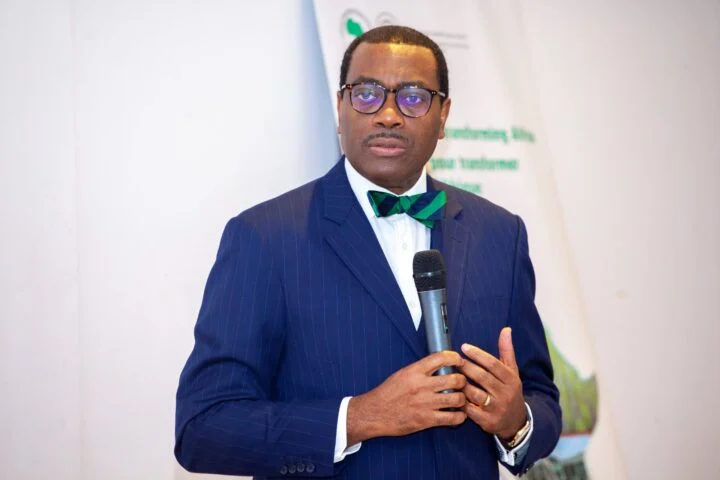
Former President of the African Development Bank, Dr Akinwumi Adesina, has proposed a $10 billion Africa Artificial Intelligence (AI) Frontier Technology Fund as the anchor for a $50 billion investment drive over the next 10 years, warning that Africa risks becoming a market for technologies developed elsewhere unless it invests in its own research, infrastructure and technology businesses.Adesina presented the proposal at the 2026 Oxford Global Think Tank Leadership Conference in Abuja, themed ‘Leadership for a Prosperous Future’, where he called for long-term financing to support the continent’s scientific, technological and industrial development. “This is not simply a proposal to raise money for AI projects. It is a proposal to build a continental financing platform capable of transforming Africa’s position in the global economy,” he said.
A $50bn Blueprint for Technological SovereigntyUnder the proposed financing structure, the $50 billion investment ambition would comprise $10 billion for the African Artificial Intelligence Frontier Technology Fund, $15 billion from African governments, $15 billion from multilateral and African development finance institutions, and $10 billion from private investors, philanthropic partners and the global technology industry. The $10 billion fund would provide catalytic financing for research, critical infrastructure, frontier technologies and African technology enterprises, serving as the anchor for the wider $50 billion mobilisation target over the 10-year period.
Adesina proposed that the fund be mobilised through development finance institutions, African governments, philanthropic organisations, financing partners and institutional investors, with its capital structure including paid-in capital, concessional resources, callable commitments and risk instruments. He also called for a Coalition for Financing Artificial Intelligence in Africa, bringing together the World Bank, African Development Bank, other multilateral development banks, African development finance institutions, governments, institutional investors and technology companies.
Adesina warned that Africa cannot be a technological leader if it does not finance its scientific ambitions, noting that if the continent fails to invest in its own research, infrastructure and technology enterprise, it risks spending the next generation purchasing technologies developed elsewhere and paying for intellectual property rights owned elsewhere. “Africa must not simply be a market for the AI revolution. We must be one of its architects,” he said, framing technological ownership as a matter of core economic sovereignty.
He outlined a five-point strategic framework: capturing economic value, investing heavily in digital and energy infrastructure, shifting from tech adoption to homegrown creation, mobilising massive institutional capital, and strengthening political leadership, which he suggested could include appointing dedicated ministers for artificial intelligence. Adesina emphasised that Africa’s youthful demography must be transformed into a ‘demographic asset class’ equipped to invent, commercialise and export advanced technologies, ensuring the continent becomes an architect of the global AI economy rather than a bystander.
Adesina said the proposed $10 billion fund and the wider $50 billion investment ambition should be assessed by the scientific discoveries, companies, intellectual property, skilled jobs and economic opportunities they generate, rather than by the amount of capital raised alone. With Africa’s population projected to reach 2.5 billion by 2050, he stressed that the continent cannot afford to depend on others for its technological needs and must determine its economic destiny.
The proposed fund would require commitments from governments, development finance institutions, private investors and philanthropic organisations to reach its $10 billion catalytic capital target and mobilise the projected $50 billion, with the proposed Coalition for Financing AI for Africa expected to provide a platform for coordinating these contributions.
Africa Presents is a Pan-African digital magazine and monthly publication covering politics, business, economy, culture, tech, and the stories shaping Africa and its diaspora. Visit africapresents.com and follow @AfricaPresents for daily coverage and monthly themed magazine editions.







Leave a comment