

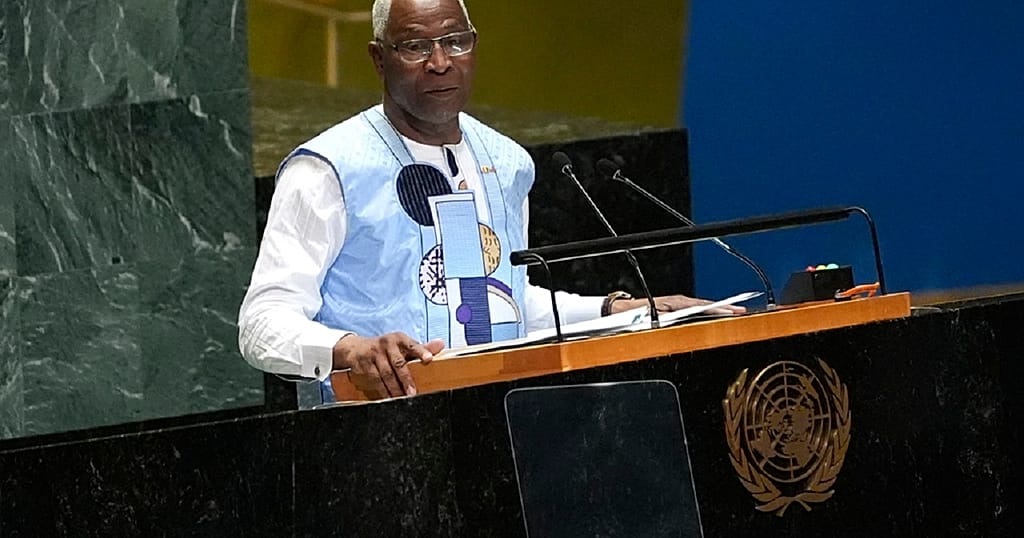
Guinean Prime Minister Amadou Oury Bah has dismissed claims that China is luring African countries into a “debt trap,” arguing that the continent’s development challenges stem more from domestic governance than from its international partnerships. Speaking on the sidelines of the World Economic Forum’s Annual Meeting of the New Champions in Dalian, China, Bah said African governments must take primary responsibility for ensuring that development partnerships deliver tangible benefits to their citizens.
“Let me be more explicit. The most critical question is whether African governments, especially our own, have the judgment and wisdom to find the best ways to turn development opportunities into real benefits for our people and our country,” the Prime Minister said. “Conversely, if we harbour the illusion that we can achieve development simply by cooperating with China, or that others will bring development opportunities directly to our doorstep while we bear no responsibility and make no necessary efforts of our own, then such thinking is clearly unrealistic and not in our best interests.”
A Relationship Spanning Decades
Bah highlighted Guinea’s long-standing relationship with China. Guinea was the first country in sub-Saharan Africa to establish diplomatic relations with Beijing in 1959, and economic ties have expanded steadily over the decades. Bilateral trade reached more than 18 billion US dollars in 2025, reflecting growing cooperation between the two countries. Speaking separately with CMG, Bah reiterated that countries should focus on improving their own governance and making effective use of development opportunities to turn cooperation into benefits for their people.
Bah’s remarks come as China’s role in financing infrastructure and development projects across Africa continues to generate debate over debt sustainability and the long-term impact of Chinese lending on the continent.
A Debate That Won’t Be Settled by One Speech
Bah’s intervention lands in the middle of a genuinely contested debate, not a settled one. Africa’s debt is largely external and denominated in foreign currencies, forcing governments to spend far more servicing it when exchange rates fluctuate and domestic currencies weaken. China has become a leading creditor for African nations, but its selective participation in international debt relief efforts complicates coordinated restructuring and weakens the effectiveness of the Paris Club process. Many countries on the continent remain trapped in a cycle where external shocks and domestic challenges force higher expenditure despite low revenue, driving more borrowing amid rising interest rates and falling credit ratings, diverting money from social services and economic activity.
At the same time, scholars sympathetic to Beijing’s position have pushed back forcefully on the “debt trap” framing itself. “Both Africans and their creditors acted in good faith and used the best available information,” said Mwangi Wachira, a former World Bank economist and adviser to the Government of Kenya, at a Global Strategic Dialogue session jointly held by the Chinese Academy of Social Sciences and China Daily.
Bah’s position effectively splits the difference between these camps, while landing firmly on the side of African agency: China’s lending is not inherently predatory, but African governments cannot outsource the responsibility of converting capital into genuine development. Whether that argument gains traction across a continent still grappling with elevated debt-service costs and tightening external financing will likely depend less on speeches in Dalian and more on what individual governments actually deliver with the partnerships they sign.
Africa Presents is a Pan-African digital magazine and monthly publication covering politics, business, economy, culture, tech, and the stories shaping Africa and its diaspora. Visit africapresents.com and follow @AfricaPresents for daily coverage and monthly themed magazine editions.







Leave a comment