

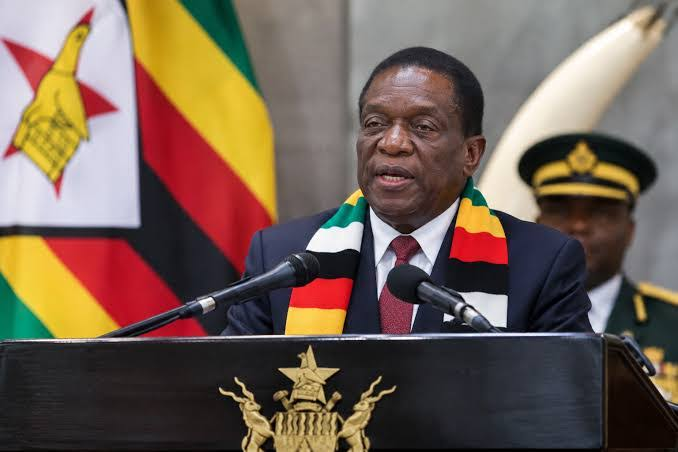
Zimbabwean President Emmerson Mnangagwa has highlighted significant economic gains in agriculture, mining and macroeconomic stability while warning that the country faces a high risk of below-normal rainfall in the 2026–2027 agricultural season that could undermine recent progress.
Delivering the State of the Nation Address at the opening of the fourth session of the 10th Parliament in Mount Hampden, Mnangagwa said the government had consolidated gains in currency and exchange-rate stability, supported by strong foreign-currency inflows. He attributed these macroeconomic improvements to a strengthened financial-sector framework, which he said should help maintain confidence in Zimbabwe’s economic environment.
Mnangagwa reported that agriculture grew by 27.9 per cent in 2025, contributing 2.2 percentage points to Zimbabwe’s overall GDP growth of 8.3 per cent for the year. He said inflation had fallen to single-digit levels since January 2026, and that foreign-currency inflows reached $10.7 billion in the first half of 2026, with projections of about $20 billion by year-end.
Mining was also highlighted as a central pillar of the economy. The president said the government is encouraging more exploration and local processing of minerals, building on recent milestones such as the commissioning of Zimbabwe’s first lithium-processing plant, which positions the country as Africa’s top producer of the battery metal. The push for value addition is intended to stop the wholesale export of raw minerals and instead capture more industrial value domestically.
Despite these gains, Mnangagwa warned that the 2026–2027 agricultural season across the Southern African Development Community (SADC) region is projected to experience below-normal rainfall, raising the spectre of renewed drought stress. He said this could place new pressure on crop production, livestock and food security if not adequately managed.
To mitigate the impact of potential drought, the president outlined a six-pillar resilience plan. This includes enhancing the strategic grain reserve, promoting climate-smart production methods, establishing an integrated financing framework for farmers, providing livestock drought-mitigation support, strengthening coordination and early-warning systems, and investing in capacity building for communities and institutions. The plan is designed to limit the economic and social shock if rainfall deficits materialise.
Mnangagwa’s message reflects the dual reality facing Zimbabwe: an economy showing signs of recovery and diversification, but one that remains highly vulnerable to climate shocks. Agriculture’s strong performance in 2025 helped drive GDP growth, yet the sector is also the most exposed to weather variability. The government’s emphasis on climate-smart farming, grain reserves and early warning is an acknowledgment that future growth will depend as much on adaptation as on production gains.
At the same time, the push to expand mining and local processing aims to reduce dependence on rain-fed agriculture and create a more diversified economic base. If successful, this could cushion the country against future droughts and external shocks. However, the effectiveness of these strategies will hinge on implementation, financing and the ability to manage both economic reform and climate risk in parallel.
For Zimbabwe, the coming year will be a test of whether recent macroeconomic stabilisation and agricultural recovery can be sustained in the face of a potentially difficult climate season. The six-pillar resilience plan offers a structured response, but its impact will depend on timely execution and adequate resources.
Mnangagwa’s address signals a government seeking to project confidence in its economic management while preparing the public and institutions for possible hardship. How Zimbabwe navigates this balance between celebrating gains and confronting climate risk will shape its trajectory towards the broader development targets it has set for the end of the decade.
Africa Presents is a Pan-African digital magazine and monthly publication covering politics, business, economy, culture, tech, and the stories shaping Africa and its diaspora. Visit africapresents.com and follow @AfricaPresents for daily coverage and monthly themed magazine editions.






Leave a comment