

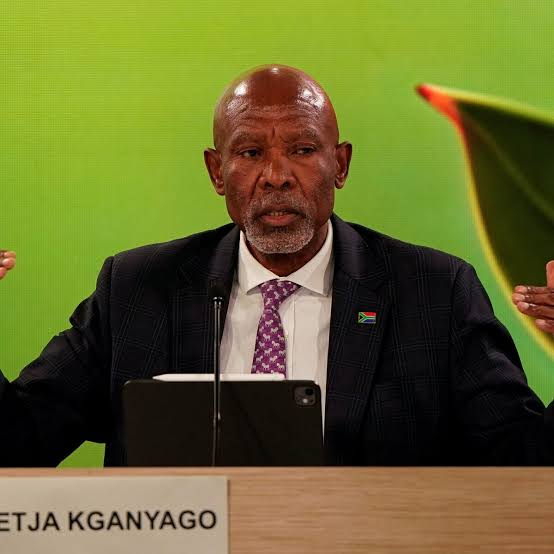
South African Reserve Bank (SARB) Governor Lesetja Kganyago has warned that the next global financial crisis could be sparked by a major cyberattack, calling on African countries to urgently establish robust regulatory and security guardrails to protect their financial systems.Speaking in Johannesburg on the 28th of September, Kganyago said sophisticated digital threats targeting national payment systems or major commercial financial firms could unleash unprecedented supply shocks and systemic economic disruptions if left unaddressed. He argued that Africa’s increasing reliance on digital finance and cross-border payment platforms makes the continent particularly vulnerable to coordinated cyber incidents.
Kganyago’s comments come as African regulators grapple with the rapid rise of fintechs, mobile money providers and non-bank payment institutions. While these innovations have expanded financial inclusion, they have also created new concentrations of risk. A disruption at one technology provider can affect several institutions, and a cyber incident can undermine confidence far beyond the institution where it begins.
The SARB governor stressed that similar payment activities should be subject to similar regulatory expectations, whether performed by a bank or a fintech. Under South Africa’s upcoming National Payment System Bill, new participants would have to take on core obligations including sound governance, safeguarding customer funds, anti-money laundering controls and ongoing supervisory oversight. Kganyago described these as “the price of admission to the payment system.”
Kganyago’s message extends beyond South Africa. He urged African nations to establish “robust safety barriers” in the form of strong cybersecurity frameworks, resilient national payment infrastructures and effective cross-border cooperation on incident response. Without such measures, he warned, a single large-scale attack could cascade through regional payment networks, trigger liquidity strains and erode trust in digital money.
The governor highlighted that Africa’s financial systems are now deeply interconnected with global markets, meaning that shocks originating on the continent can spill over, and vice versa. In this context, weak cyber defences in one jurisdiction can become a vulnerability for the entire region.
Kganyago pointed to South Africa’s own experience as an example of how sustained investment in supervision and risk management can build resilience. He noted that the country’s financial system remains among the most robust and well-regulated in the world, reflecting years of rigorous oversight, stronger systemic risk frameworks and recent progress such as exiting the Financial Action Task Force (FATF) greylist.
At the same time, he acknowledged that no system is immune. The SARB has been stress-testing banks and payment system operators against severe cyber scenarios, working with the private sector to improve incident reporting, backup arrangements and recovery plans. Kganyago said other African countries can draw on these lessons as they design their own regulatory architectures for digital finance.
For African finance ministers, central bankers and regulators, Kganyago’s warning underscores the need to treat cybersecurity as a core element of financial stability, not just an IT issue. This includes enacting clear laws on data protection and cybercrime, empowering supervisors to oversee non-bank payment providers, and investing in national computer emergency response teams that can coordinate with financial authorities.
Regional bodies such as the African Union and the African Development Bank can play a role by supporting harmonised standards, sharing threat intelligence and helping smaller jurisdictions build capacity. As Africa’s digital economy grows, the cost of inaction on cyber risk is likely to rise faster than the cost of putting strong safeguards in place.
Kganyago’s central message is that Africa cannot afford to wait for a crisis to act. “The next global financial crash could be sparked by a major cyberattack,” he said, framing robust safety barriers as essential infrastructure for the continent’s economic future. For African leaders, the challenge is to ensure that the same innovation driving financial inclusion also rests on a foundation of security, trust and resilience.
Africa Presents is a Pan-African digital magazine and monthly publication covering politics, business, economy, culture, tech, and the stories shaping Africa and its diaspora. Visit africapresents.com and follow @AfricaPresents for daily coverage and monthly themed magazine editions.







Leave a comment