

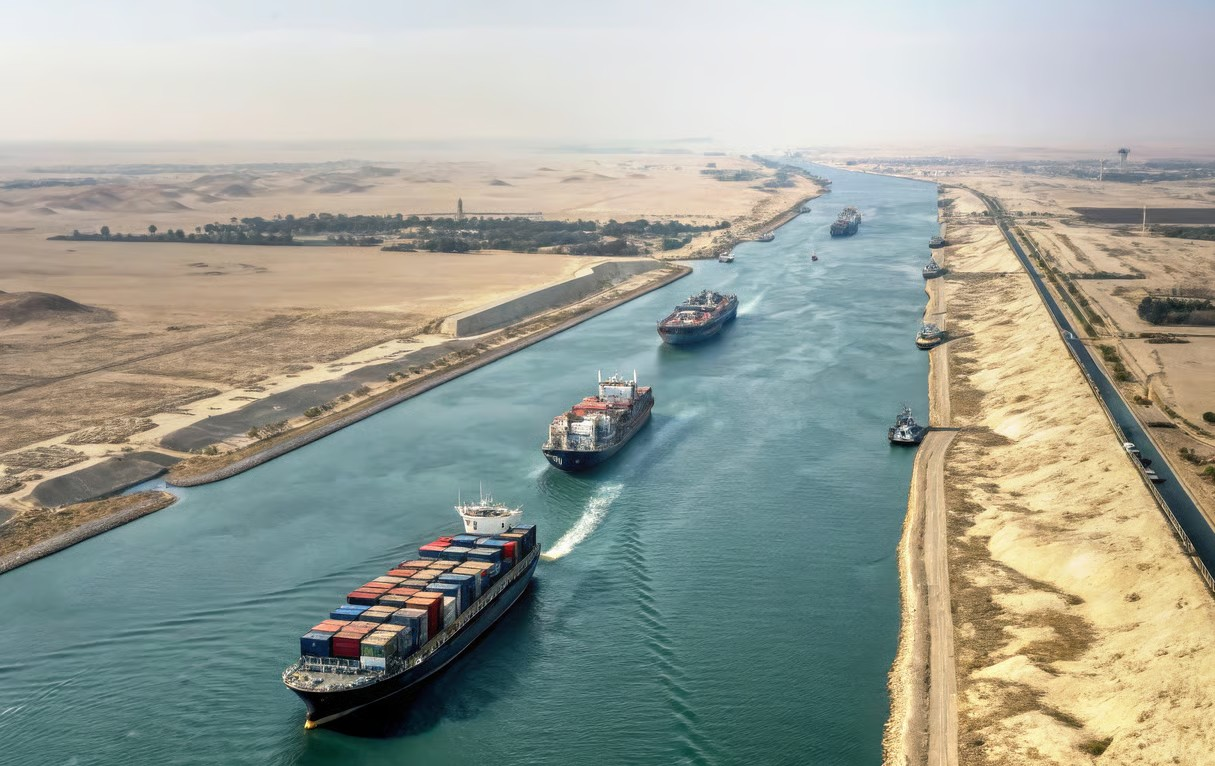
Egypt is building a high-speed rail network designed to give cargo an overland route between the Red Sea and the Mediterranean, reducing the country’s exposure to disruptions along the Suez Canal.
The centrepiece is an $8.7 billion electrified high-speed rail line spanning roughly 2,000 kilometres across Egypt. Once fully operational, it is expected to carry up to 13 million tonnes of freight annually, allowing cargo to move between Red Sea ports and Mediterranean export terminals without relying solely on the canal.
The project has been dubbed the “Suez Canal on Rails” because it creates a direct land connection between Egypt’s Red Sea and Mediterranean coasts. The first 660-kilometre corridor links Ain Sokhna on the Red Sea with Alexandria, New Alamein and Marsa Matrouh on the Mediterranean, and is designed for both passenger and freight services.
The line is not intended to replace the Suez Canal, whose scale and role in global maritime trade remain unmatched. Instead, it is positioned as a complementary domestic transport corridor that can move cargo efficiently between Egypt’s eastern and northern ports while reducing reliance on long-haul trucking.
The push for an overland alternative comes as the Suez Canal has faced repeated disruptions in recent years, from geopolitical tensions to shipping incidents that have highlighted the risks of relying on a single maritime chokepoint. By building rail capacity, Egypt aims to protect its economic engine and preserve its status as a global trade hub.
The network is centred on the Suez Canal Economic Zone, which has attracted more than $16 billion in investment. The rail project is part of a broader strategy to integrate ports, logistics and high-speed transport to strengthen regional trade.
In addition to the main high-speed line, Egypt is advancing a roughly 500-kilometre railway from the El-Ferdan Bridge over the Suez Canal to Taba, near the Israeli border. Known as the al-Arish–Taba international logistics corridor, the project is designed to link the Mediterranean to the Red Sea overland and could serve as a backup route for certain types of cargo.
The corridor also aims to inject economic life into the desert interior and strengthen Egyptian sovereignty in the region. Together, the two rail projects represent a significant investment in infrastructure that could reshape how cargo moves across Egypt and the wider region.
Africa Presents is a Pan-African digital magazine and monthly publication covering politics, business, economy, culture, tech, and the stories shaping Africa and its diaspora. Visit africapresents.com and follow @AfricaPresents for daily coverage and monthly themed magazine editions.







Leave a comment