

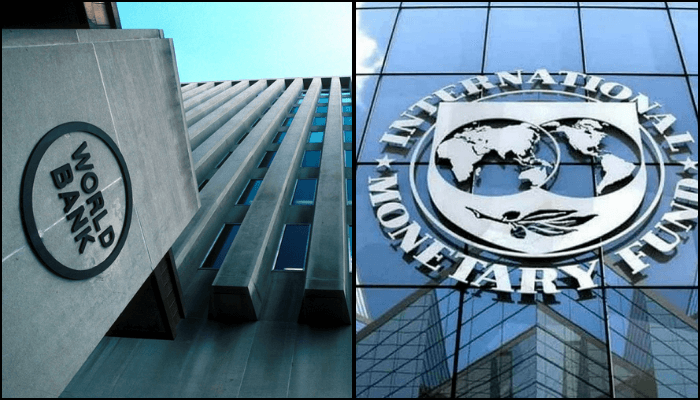
At the 2026 IMF-World Bank Spring Meetings in Washington, African finance ministers arrived not as supplicants but as negotiators, carrying a unified message: the issue is no longer access to finance, but the terms on which it is offered. The defining statistic circulating among policymakers was stark. Four out of five African governments now spend more on debt servicing than on health or education. In 2025, nearly one in every five dollars of public revenue was absorbed by debt payments alone.
This is the context in which the debate over IMF and World Bank loan conditionality is being conducted in 2026. It is not an academic debate. It is a question about who makes economic decisions for African citizens, and whose interests those decisions ultimately serve.
The History That Shapes the Present
The debate over conditional lending is not new. Critics have long argued that Structural Adjustment Programmes introduced by the World Bank and IMF during the 1980s and 1990s weakened public services in parts of Africa through spending cuts, privatisation, and market reforms. Supporters argue that many reforms addressed longstanding economic weaknesses and helped restore financial stability, while critics say the social costs were underestimated. Some academic studies have associated IMF-linked structural adjustment programmes with adverse health outcomes in parts of sub-Saharan Africa, although the findings remain debated.
What has changed in 2026 is not the structure of the debate but its intensity, driven by a financing environment that has shifted sharply against Africa. The 2026 IMF-World Bank Spring Meetings came at a critical moment of economic stress, tightening global financial conditions, and increasing geopolitical complexities. Energy market turmoil stemming from conflict in the Middle East is straining the debt burdens of vulnerable countries, raising the potential of a new wave of defaults.
What Conditionality Actually Looks Like
Across Africa, reforms linked to international financing have often included politically sensitive measures such as tax increases, subsidy reductions, and spending controls. Lenders argue that such measures are necessary to restore fiscal stability and reduce debt risks. Critics say they can increase living costs and place pressure on households already struggling with economic challenges.
Kenya’s 2024 anti-Finance Bill protests, which later expanded into wider antigovernment demonstrations, highlighted the political sensitivity surrounding fiscal reforms. Rights groups and other observers reported more than 60 deaths during the unrest. The protests followed tax proposals introduced as Kenya sought to meet fiscal targets under its IMF-supported programme. Kenya is not an isolated case. It is the most visible recent example of a pattern that has played out across the continent for four decades.
The IMF is currently conducting its first Review of Program Design and Conditionality since 2018, to evaluate and improve its lending practices. To receive IMF support, countries are required to meet certain conditionalities, which tend to require fiscal consolidation and economic liberalisation.
What African Governments Are Saying
African delegations to the 2026 Spring Meetings used the moment to push back. Progress was measured rather than transformative. The IMF revised its growth forecast for Sub-Saharan Africa to 4.3% in 2026, reflecting growing divergence between commodity exporters and more vulnerable fuel-importing economies. On structural issues, the official communiqué offered cautious but positive signals, with the ongoing review of the Low-Income Country Debt Sustainability Framework framed as strengthening the joint IMF-World Bank toolkit.
Kenya’s efforts to diversify its financing sources, including through international bond markets, reflect a desire to reduce dependence on conditional multilateral lending. Egypt’s Samurai bond programme, Tanzania’s domestic gold purchases, and Nigeria’s Eurobond issuances all point to the same instinct: African governments are actively seeking financing that does not come with policy conditions attached.
The Deeper Question
While the IMF and World Bank play critical roles in providing financial assistance to African nations during economic crises, their policies and loan structures often contribute to a cycle of debt and poverty. African countries have to push for lower interest rates, fewer loan conditions, and initiatives like open-border free trading to reduce reliance on foreign assistance.
The case for multilateral lending is real: it provides access to financing that many African governments could not otherwise obtain at any price. The case against its current terms is equally real: a continent that cannot set its own tax, spending, or social policy without creditor approval is a continent whose sovereignty is qualified, not absolute.
The 2026 Spring Meetings did not resolve that tension. They sharpened it. What African governments do with that sharpened clarity, in bond markets, in domestic revenue mobilisation, and in collective bargaining through the AU and AfCFTA, will determine whether the next decade looks different from the last four.
Africa Presents is a Pan-African digital magazine and monthly publication covering politics, business, economy, culture, tech, and the stories shaping Africa and its diaspora. Visit africapresents.com and follow @AfricaPresents for daily coverage and monthly themed magazine editions.






Leave a comment