

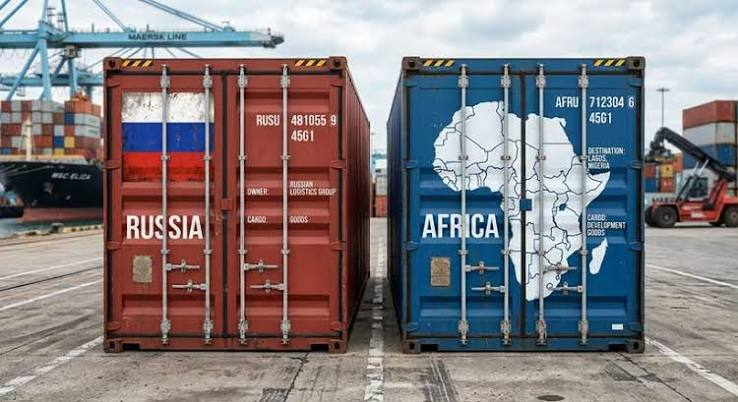
Russia has widened its political and diplomatic reach across Africa, but its economic engagement remains far behind its diplomatic ambitions, with African governments increasingly demanding investment, technology transfer and industrial partnerships rather than security agreements alone.
Russia’s trade with Africa reached approximately $27 billion in 2025, against around $348 billion for China and $367 billion for the European Union, with Moscow providing only about one per cent of total foreign direct investment into the continent, while Russian exports to Africa exceed imports by roughly seven times, highlighting a lopsided commercial relationship. The Third Russia-Africa Summit, held in Moscow on October 28th-29th, 2026, brought together representatives from 48 African countries, with the Action Plan of the Russia-Africa Partnership Forum for 2027-2029 comprising 236 individual measures aimed at deepening cooperation across trade, energy, agriculture, technology and security.
Russia pledged in 2019 to double its annual trade with Africa to $40 billion within five years, but the target has not been met, with trade instead shrinking to about $14 billion by 2024 due to the COVID-19 pandemic and the Kremlin’s full-scale invasion of Ukraine in 2022, before recovering to exceed $27 billion in 2025. At the 2026 summit, Putin set a new goal of reaching $50 billion in trade with the continent in the “near future”, though no specific timeline was provided, with the 2027-2029 Action Plan providing a framework for further economic cooperation but leaving the extent of implementation uncertain.
The gap between Russia’s diplomatic outreach and its economic delivery is evident in the composition of its engagement, with the country’s footprint on the continent dominated by arms sales, grain exports, nuclear contracts and security deployments rather than broad-based commercial investment, with Russian investment concentrated largely in resource extraction and energy, particularly the El Dabaa nuclear power plant in Egypt. The 2027 state budget, which projects a substantial deficit of 5.44 trillion rubles alongside cuts to numerous investment programmes, further limits Moscow’s ability to underwrite the large-scale infrastructure and industrial investments many African governments increasingly demand.
African leaders at the summit courted Russian investment in bilateral meetings, with countries seeking partnerships that would spur industrialisation, create jobs and reduce dependence on external partners, but few major, tangible bilateral agreements emerged from the gathering, with the Russian aluminium company Rusal and Ghana’s state-owned Ghana Integrated Aluminium Development Corporation signing an agreement to develop a bauxite mine at Ghana’s Nyinahin deposit being one of the few concrete outcomes. African governments want investment that creates jobs and reduces dependence, alongside grain supplies and security agreements, with the summit’s outcomes indicating an effort to move beyond political declarations but leaving implementation as the key test, particularly in realising tangible benefits for African partners.
The challenge for Russia is to convert its diplomatic gains into meaningful economic outcomes, with sanctions, infrastructure constraints and disrupted supply chains limiting its ability to match the scale of Chinese or Western investment, while African governments’ expectations of investment, technology transfer and local industrial development remain largely unmet by the current pattern of engagement. The country’s strategy of targeting specific regions, particularly the Sahel, West Africa, Central Africa and the Horn of Africa, has allowed it to gain influence with a relatively modest investment, but the question remains whether this approach can deliver the developmental benefits African countries increasingly seek.
The 2027-2029 Action Plan’s 236 measures will need to be translated into financed projects, signed agreements and concrete economic results if Russia is to close the gap between its diplomatic ambitions and its economic footprint, with the plan’s focus on investment in extraction and processing of critical raw materials, establishment of Russian industrial zones with localised production, and development of joint production facilities for medicines, vaccines and civilian drones representing potential areas for deeper engagement. The extent to which these projects are implemented and translated into concrete economic results will become clear in the coming years, with the summit’s outcomes providing a framework but not a guarantee of delivery.
The outcome of Russia’s engagement with Africa will likely depend on its ability to overcome the structural constraints limiting its economic capacity, including sanctions, financial constraints and the ongoing war in Ukraine, while African governments’ willingness to partner with Russia will depend on whether Moscow can deliver on its promises of investment, technology transfer and industrial development rather than relying solely on security cooperation and political relationships. The challenge for both sides is to build a partnership that delivers tangible benefits for African countries, rather than one that remains primarily transactional and security-focused.
Africa Presents is a Pan-African digital magazine and monthly publication covering politics, business, economy, culture, tech, and the stories shaping Africa and its diaspora. Visit africapresents.com and follow @AfricaPresents for daily coverage and monthly themed magazine editions.







Leave a comment