

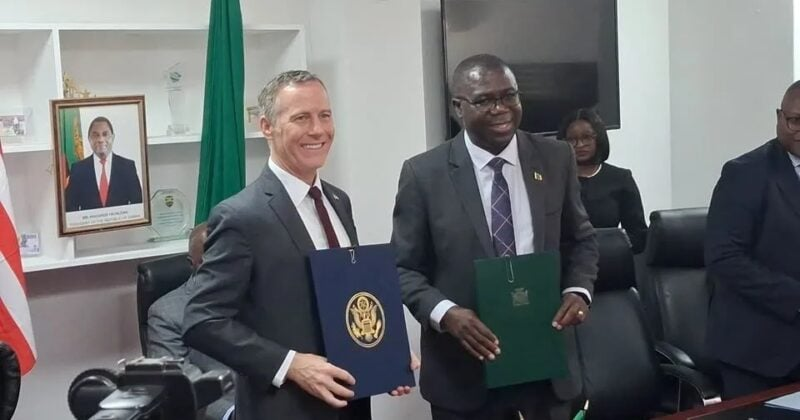
Zambia has signed a five-year health financing agreement with the United States, ending months of public dispute over whether the country was trading citizens’ medical data and mineral rights for aid.
The memorandum of understanding, signed in Lusaka on Thursday, includes a data-sharing arrangement but removes contentious clauses that had sparked national outrage. Under the revised deal, the US will provide about $1.5 billion (£1.1 billion), with Zambia also contributing to a total package variously reported at $2.49 billion to $3.6 billion, depending on whether domestic co-financing is included.
Negotiations stalled earlier in 2026 over Lusaka’s concerns about data privacy and a US attempt to tie the funding to access to critical minerals. Civil society organisations raised alarms after a leaked draft of the agreement appeared to permit excessive data sharing and the transfer of biological specimens to the US.
Zambian Health Minister Roma Chilengi said provisions requiring Zambia to send biological specimens to the US have been eliminated, and the agreement will not permit the sharing of individual patient records. He noted that data exchange would be restricted to information necessary for monitoring and evaluating the programmes funded by the agreement.
Under the Data Sharing Agreement attached to the health MOU, no personally identifiable information will be exchanged. Only aggregated, de-identified programme data will be shared, and Zambia retains ownership and control of its data under its own laws.
The US State Department said the deal is worth a total of $2.49 billion, with the US contributing $1.52 billion and Zambia investing $975 million into its health system over the next five years. Other Zambian officials have cited a larger $3.6 billion figure when including broader domestic health spending linked to the partnership.
For Zambia, the outcome is being framed as a victory for national sovereignty and data protection. The government has insisted that the health deal is not coupled to any agreement on US access to the country’s mineral resources, pushing back against claims that aid was being used to secure strategic advantages.
The dispute highlighted growing sensitivity across Africa about the terms of health and development assistance, particularly where data, specimens and natural resources are concerned. Zambia’s insistence on removing specimen-sharing and individual data clauses sets a precedent that other countries may seek to emulate in negotiations with external partners.
The funding is expected to support priority health programmes in Zambia, including HIV/AIDS, maternal and child health, and health systems strengthening. By limiting data sharing to aggregated, programme-level information, the agreement aims to balance accountability for US-funded interventions with Zambia’s data sovereignty and privacy concerns.
As the deal moves into implementation, attention will turn to whether the promised resources translate into measurable health gains without compromising national control over sensitive data. For now, Lusaka presents the signed MOU as evidence that it is possible to secure vital health financing while standing firm on data and sovereignty.
Africa Presents is a Pan-African digital magazine and monthly publication covering politics, business, economy, culture, tech, and the stories shaping Africa and its diaspora. Visit africapresents.com and follow @AfricaPresents for daily coverage and monthly themed magazine editions.







Leave a comment