

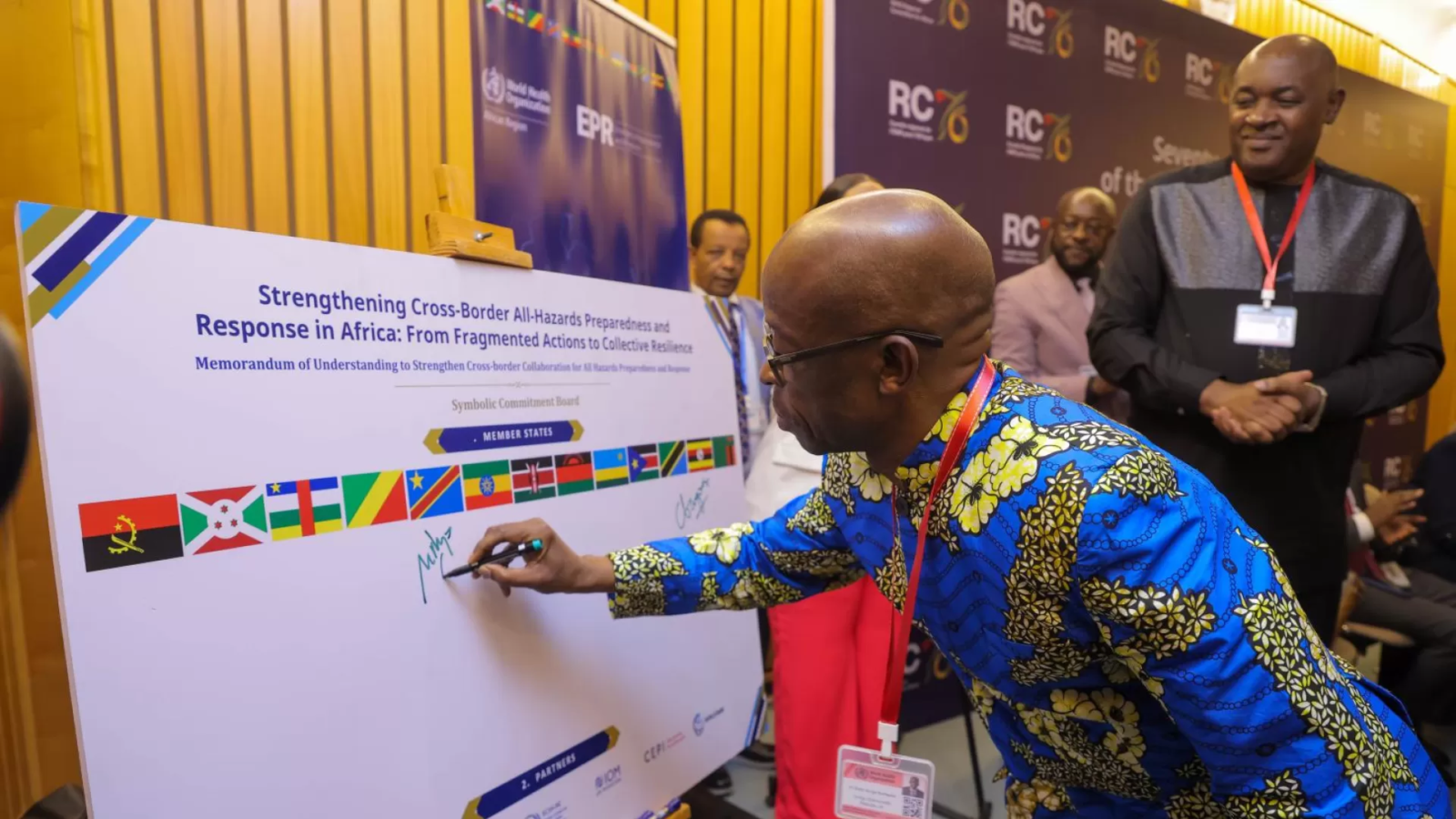
Ten African countries have signed a Cross-Border Collaboration Memorandum of Understanding to strengthen coordination, information-sharing and joint preparedness for public health emergencies.
The agreement was signed by health ministers on the sidelines of the 76th Session of the WHO Regional Committee for Africa in Addis Ababa, Ethiopia, in late August 2026. It creates a framework for countries to work together before, during and after health crises, with a focus on early detection, coordinated response and clearer roles along high-risk border areas.
The ten signatories are Burundi, the Democratic Republic of the Congo, Eswatini, Ethiopia, Kenya, Rwanda, South Sudan, Tanzania, Uganda and Zimbabwe.
Under the MoU, participating countries commit to strengthening cross-border disease surveillance and real-time sharing of health data, harmonising alert mechanisms and health measures at points of entry such as airports, seaports and land borders, and coordinating joint preparedness and response activities, including training and simulations. They also agree to facilitate the movement of medical teams, samples and essential supplies across borders during emergencies and to engage border communities in preparedness efforts and risk communication.
The pact is supported technically by the WHO Regional Office for Africa and aligns with broader continental efforts under the Africa Centres for Disease Control and Prevention to improve health security.
Infectious diseases do not respect national boundaries. Outbreaks of Ebola, mpox, cholera and other pathogens have repeatedly spread across borders in the Great Lakes region, the Horn of Africa and southern Africa, exposing gaps in coordination and delayed responses. The new agreement seeks to address these weaknesses by establishing common protocols and clearer lines of communication between neighbouring countries. It also aims to reduce duplication, speed up decision-making and ensure that border communities are not left behind during emergencies.
The MoU comes amid a series of related initiatives. In August 2026, the East, Central and Southern Africa Health Community launched a cross-border Ebola preparedness strategy covering 33 priority points of entry in 10 countries, while the IGAD region has been developing a multi-country MoU on mpox and other health threats. Separately, 13 African countries, including Ethiopia, Kenya, Uganda, Angola and Tanzania, signed another MoU during RC76 on disease prevention, health-data sharing and joint provision of medical supplies, underscoring growing political commitment to regional health security.
Implementation will depend on translating the MoU into national action plans, designating focal points in each country and securing resources for joint activities. Regular reviews and cross-border simulations will be critical to test the system before the next major outbreak.
For the ten signatories, the agreement represents a concrete step toward a more integrated and resilient health architecture. If effectively operationalised, it could reduce the time between detection and response, limit cross-border transmission and save lives across the region.
Africa Presents is a Pan-African digital magazine and monthly publication covering politics, business, economy, culture, tech, and the stories shaping Africa and its diaspora. Visit africapresents.com and follow @AfricaPresents for daily coverage and monthly themed magazine editions.







Leave a comment