

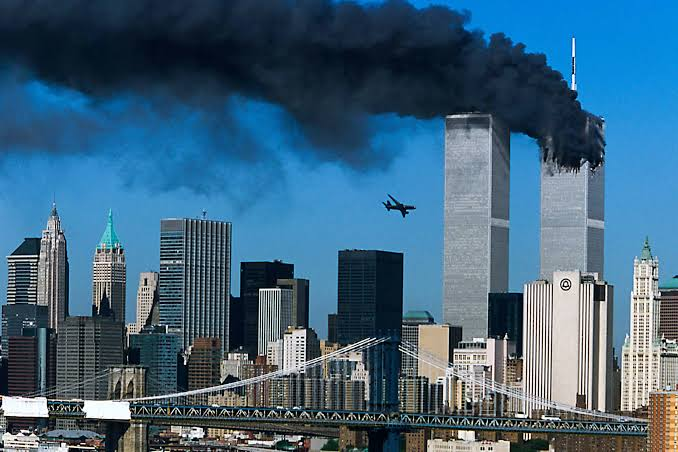
Twenty-five years after the September 11 attacks, the legacy of the deadliest terrorist attack on US soil continues to reshape how Africans cross borders, travel and migrate, embedding security concerns at the heart of global mobility systems.
On 11 September 2001, 19 al-Qaeda terrorists hijacked four commercial aircraft, killing nearly 3,000 people and triggering a US-led security response that fundamentally transformed international relations, diplomacy and global movement. For Africans and the diaspora, the post-9/11 era has meant a global mobility system increasingly defined by security screening, biometric identification, intelligence sharing and stricter border controls.
Before 9/11, international travel and migration were largely framed around economic opportunity, family reunification and humanitarian protection. After the attacks, movement across borders became a question of national security, with controls tightening, management growing more intrusive and air travel fundamentally transformed, analysts say.
Governments placed counterterrorism at the centre of diplomatic relationships, while security agencies expanded their role in monitoring movement. At the international level, states adopted stricter passport standards, expanded biometric identification, increased information sharing and introduced rigorous pre-screening of travellers. For African passport holders, this often translated into longer visa processes, more document requirements and heightened scrutiny at airports and borders.
The US-led “war on terror” that followed 9/11 also had direct consequences for Africa. Military interventions and counterterrorism operations in Afghanistan, Iraq, Libya, Somalia, the Sahel and beyond contributed to the displacement of an estimated 38 million people across several countries, including in Africa. As conflicts intensified and governance weakened, new migration routes opened, while existing ones became more dangerous and irregular.
At the same time, al-Qaeda’s core weakened but its regional affiliates grew stronger, particularly in parts of Africa such as the Sahel, Lake Chad Basin, Somalia and Mozambique. These groups exploited ungoverned spaces, local grievances and porous borders, further securitising migration and border management across the continent.amp.
For African governments, the post-9/11 order brought both pressure and opportunity. Many aligned with Western counterterrorism agendas, gaining security assistance and training, but also adopting stricter migration and asylum policies. Regional bodies such as the African Union and ECOWAS have sought to balance free movement commitments with new security imperatives, introducing biometric passports, shared watchlists and joint border operations.
Yet the human cost is visible in longer queues at embassies, higher rejection rates for visas, more deportations and the criminalisation of irregular movement. Migration management is now often indistinguishable from border security, with development, trade and mobility policies increasingly filtered through a counterterrorism lens.
Twenty-Five Years Later
A quarter of a century on, the fundamental question remains whether security and openness can coexist. The attacks may have happened 25 years ago, but their influence is still visible every time an African traveller presents a passport, submits biometric information, passes through an airport security checkpoint or applies for a visa.
For Africa, the 9/11 legacy is not only about terrorism or war. It is about how a single event helped rewire the global system of movement, turning migration into a security issue and reshaping the opportunities and obstacles facing millions of Africans on the move.
Africa Presents is a Pan-African digital magazine and monthly publication covering politics, business, economy, culture, tech, and the stories shaping Africa and its diaspora. Visit africapresents.com and follow @AfricaPresents for daily coverage and monthly themed magazine editions.





Leave a comment