

A proposed iron ore corridor linking the Central African Republic (CAR) to Cameroon’s deep-water port of Kribi is being touted as a potential game-changer for global dry bulk shipping, with analysts suggesting it could generate demand equivalent to around 5 per cent of the world’s seaborne iron ore trade by the late 2030s.
UK-based A&S Resources, which is developing iron ore assets in CAR, has announced plans to build a roughly 1,350-kilometre heavy-haul railway from its deposits near Bangui to Kribi, backed by a $6 billion financing commitment from the Export-Import Bank of India. The company says the line would initially carry 250,000 tonnes of cargo per day, with capacity scalable to 300,000 tonnes, translating into annual export volumes of more than 90 million tonnes once fully ramped up.
A&S Resources estimates that its Bakala/Topa and Bogoin properties in CAR hold more than 20 billion tonnes of high-grade iron ore, predominantly above 64.5 per cent iron content, with an in-situ value it puts at around $2.5 trillion. The proposed dual-track railway is designed as a dedicated mineral corridor, connecting landlocked CAR to the Atlantic via Kribi, which has been expanded over the past 15 years into Central Africa’s largest port.
If the corridor reaches its design capacity, annual iron ore exports could exceed 90 million tonnes, with some scenarios pointing towards 100 million tonnes. Shipping analysts note that such volumes would be comparable to a mid-sized global iron ore province and large enough to move markets, particularly if cargoes are split between major Asian buyers such as China and India.
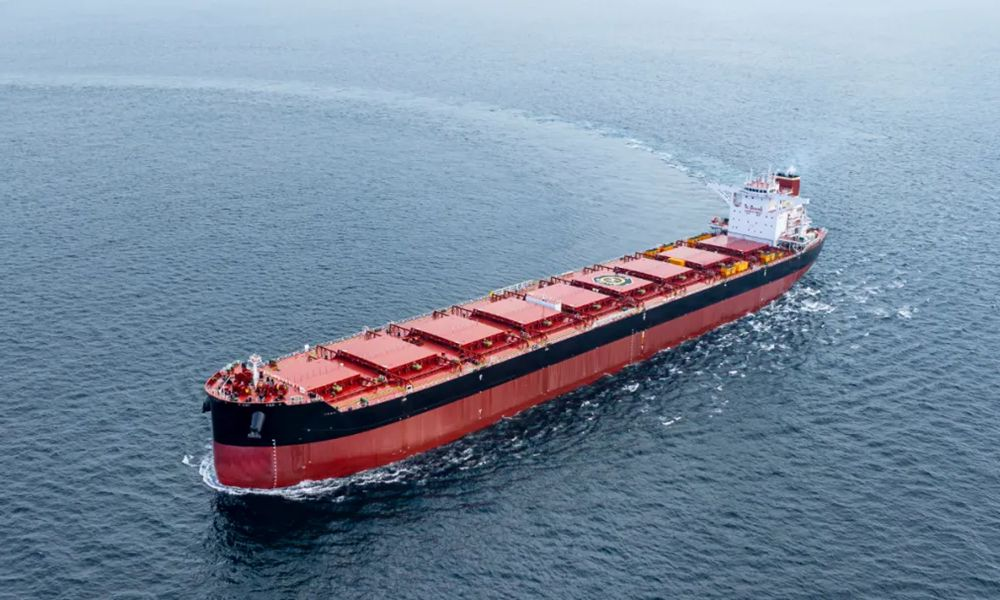
The Hellenic Shipping News and Eagle Intelligence have highlighted the corridor’s potential impact on Capesize vessel demand. Capesize bulk carriers, which typically transport cargoes of around 150,000 to 180,000 tonnes of iron ore and coal, are highly sensitive to changes in long-haul trade flows. If Kribi exports about 100 million tonnes of iron ore annually, with roughly half going to China and half to India, the resulting tonne-miles could exceed 500 billion. That, in turn, could underpin demand for an additional 70 to 80 Capesize vessels by the late 2030s.
Such a shift would also affect trade patterns. Increased shipments from Central Africa to Asia could lead both China and India to diversify away from some Australian iron ore, lengthening average haul distances and tightening Capesize supply on key routes. For shipowners and investors, the CAR–Kribi corridor represents a potential new growth pole in an otherwise mature dry bulk market.
The CAR–Kribi project is part of a broader wave of Central and West African iron ore developments that are reshaping the global supply map. Guinea’s Simandou project, the world’s largest high-grade iron ore reserve, began exports in late 2025 and early 2026 via a new 600-plus-kilometre railway to the coast, already adding significant Capesize demand. In parallel, the Mbalam-Nabeba project straddling Cameroon and the Republic of Congo is advancing with its own rail link to a coastal terminal, also targeting high-grade exports.
Viewed together, these projects signal the emergence of a new Central African iron ore belt that could rival established basins in Australia and Brazil in terms of grade, if not yet in scale. For Cameroon, the CAR corridor would reinforce Kribi’s role as a regional hub, building on container traffic that has quadrupled since 2018 and total cargo volumes that exceeded 12.7 million tonnes in 2024.
Despite the ambition, significant risks remain. CAR is landlocked and has a history of political instability and security challenges, meaning the viability of the corridor depends on sustained peace, strong governance and effective coordination with Cameroon. The railway itself is a capital-intensive, cross-border infrastructure project that will require careful management of construction, operations and maintenance over decades.
Port capacity at Kribi will also need to evolve. While port authorities say existing and recently expanded terminals can handle initial mineral shipments, sustained exports on the scale envisaged would likely require dedicated ore-handling facilities, deeper berths and enhanced rail-to-port integration. Financing, environmental and social safeguards, and community impacts along the route are additional factors that could shape the project’s timeline and ultimate scale.
If delivered as planned, the CAR–Kribi iron ore corridor could become one of the most significant new sources of Capesize demand in the next decade, alongside Simandou and other African projects. For a shipping market that has seen limited organic growth in iron ore volumes outside Australia and Brazil, Central Africa offers a rare combination of high-grade resources, greenfield infrastructure and long-haul trade routes to Asia.
The question for investors, shipowners and traders is not just whether the resource is there—analysts agree it is—but whether the political, financial and operational conditions can be sustained long enough to unlock it at scale. If they are, the CAR–Kribi corridor could well emerge as a defining story for Capesize markets in the 2030s.
Africa Presents is a Pan-African digital magazine and monthly publication covering politics, business, economy, culture, tech, and the stories shaping Africa and its diaspora. Visit africapresents.com and follow @AfricaPresents for daily coverage and monthly themed magazine editions.






Leave a comment