

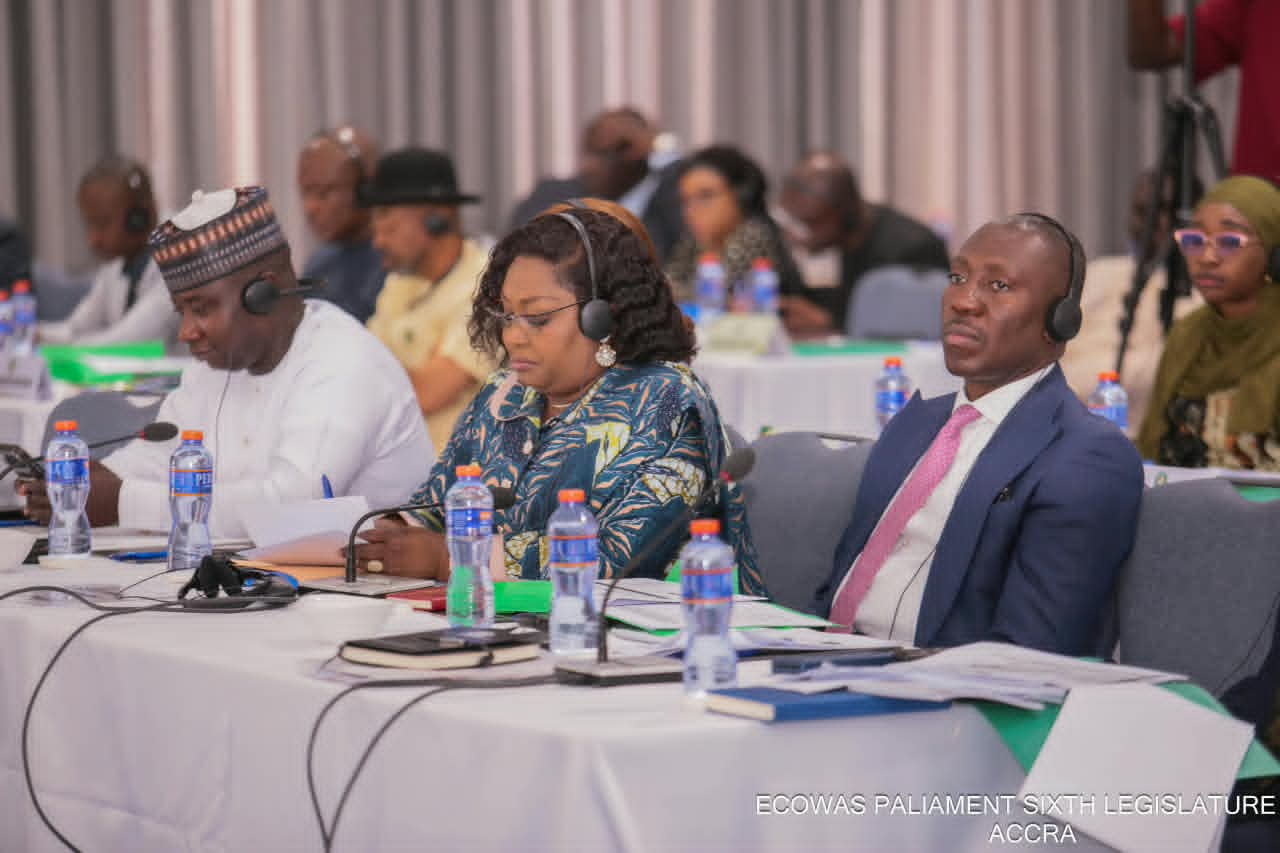
The ECOWAS Parliament has issued a stark warning that climate change is no longer a distant threat in West Africa but a present driver of environmental degradation, mass displacement and rising insecurity, urging member states to adopt practical, people-centred responses.At the Second Extraordinary Session and Second Parliamentary Seminar of the Sixth Legislature in Accra, Ghana, Speaker Hadja Mémounatou Ibrahima said the climate crisis must be viewed not only as an environmental issue but as a deeply human one. “Climate disruption can no longer be measured only in degrees, statistics or projections,” she said. “It is read in land that yields less, in coastlines that retreat, in flooded neighbourhoods, in families losing their livelihoods, and in communities forced to relocate.”
The seminar, themed “Climate Change as a Driver of Environmental Degradation, Population Displacement and Rising Insecurity in the ECOWAS Region,” brought together parliamentarians, experts and officials to examine how environmental stress is reshaping livelihoods and stability across West Africa.
Manuel Nascimento Lopes, a Guinea-Bissau lawmaker at the ECOWAS Parliament, warned that failure to protect the environment could expose future generations to worsening flooding, displacement and insecurity. Experts told the session that rising temperatures, extreme weather events, drought, flooding and land degradation were compounding existing economic and social vulnerabilities, threatening infrastructure and regional stability.
Highlighting the scale of the challenge, Ghana’s Environmental Protection Authority (EPA) disclosed that the country alone will need an estimated $22.6 billion to implement its climate action plans by 2030. Dr Derek Sarfo-Yiadom, senior programme officer at the EPA’s Climate Change and Ozone Directorate, said climate hazards were already affecting communities across West Africa, citing extreme heat, drought, heavy and unpredictable rainfall and rising sea levels as major concerns.
Experts called for stronger regional cooperation, increased investment in climate adaptation, improved early-warning systems and better access to climate finance to enable member states to respond effectively to growing climate risks. The discussions underscored the need to move beyond technical debates to concrete policies that protect affected populations and reduce the security risks linked to environmental disruption.
Speaker Ibrahima urged parliamentarians to confront the human cost of climate change and to push for practical measures to protect vulnerable communities. She warned that climate change was fuelling displacement and insecurity as environmental disruption increasingly affected livelihoods, communities and the security of populations across the sub-region.
The ECOWAS Parliament’s intervention adds political weight to ongoing efforts by the bloc and its partners to promote climate action, agroecological innovations and sustainable development in West Africa. Recent initiatives, including a new project to promote agroecological innovations launched in Lomé, are framed as concrete responses to the adverse effects of climate change on production systems and food security.
For lawmakers, the message is clear: climate policy in West Africa must now be designed as much around people, displacement and security as around emissions and temperature targets.
Africa Presents is a Pan-African digital magazine and monthly publication covering politics, business, economy, culture, tech, and the stories shaping Africa and its diaspora. Visit africapresents.com and follow @AfricaPresents for daily coverage and monthly themed magazine editions.






Leave a comment