

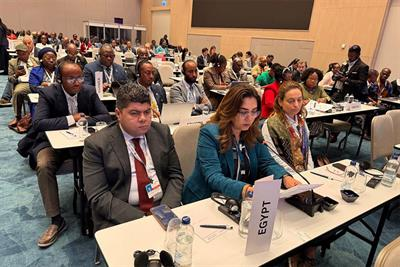
Egyptian Environment Minister Manal Awad has said African countries should not be expected to take on additional climate obligations without the financing, technology transfer and capacity building needed to fulfil them, calling for adaptation finance to be tripled by 2035 and greater resources allocated to addressing loss and damage.
Awad made the remarks during a high-level consultative meeting of African environment ministers in Antalya on the sidelines of COP31, where officials discussed coordinating the continent’s positions during the final phase of climate negotiations, with the success of COP31 measured by its ability to translate existing commitments into tangible action and implementation rather than produce additional pledges unsupported by adequate financing and delivery mechanisms. Egypt and the African Group are working to ensure that developed countries uphold their climate-finance obligations under Article 9 of the Paris Agreement, with funding that is concessional, predictable and accessible.
Awad described climate adaptation as an existential priority for Africa, calling for a clear pathway to triple adaptation finance by 2035 and for progress on the Global Goal on Adaptation and the Baku Adaptation Roadmap, while also urging greater funding for the Fund for Responding to Loss and Damage, alongside faster and more direct access to its resources for developing countries and climate-vulnerable communities. The African Group of Negotiators (AGN) has been pressing for a dedicated agenda item on tripling adaptation finance since the climate talks in Bonn, Germany, in June, but the proposal failed to reach consensus at COP31’s opening session, with COP31 president Murat Kurum ruling that it could instead be discussed under existing agenda items.
The dispute over adaptation finance reflects a broader challenge facing developing countries, with the United Nations Environment Programme’s (UNEP) Adaptation Gap Report 2026 estimating that developing countries will need approximately $305 billion annually by 2035 to meet their adaptation needs, while even if the proposed tripling is achieved, it would cover only 20 to 29 per cent of developing countries’ adaptation needs. Developing countries want the $40 billion baseline to be used for tripling, which would bring the annual target to $120 billion by 2035, but developed countries are contesting this calculation, with discussions around the baseline still unresolved.
Awad stressed the need to prioritise grants and financing mechanisms that do not add to African countries’ debt burdens, arguing that the continent cannot be expected to raise its climate ambition without the necessary resources to implement its commitments, while calling on African countries to maintain a unified negotiating position and avoid trade-offs between key priorities, particularly climate finance, adaptation and mitigation. The final COP31 decision should strike a balance between mitigation, adaptation, climate finance, loss and damage, technology transfer and capacity building, while upholding the principles of equity and common but differentiated responsibilities.
Participants agreed to maintain political and technical coordination throughout the remaining COP31 negotiations, focusing on climate finance, adaptation, loss and damage and the just transition, with the African Group’s push for a dedicated agenda item on tripling adaptation finance reflecting a broader effort to ensure that Africa’s development priorities are reflected in the global climate agenda. The outcome of COP31 negotiations will likely determine whether African countries can secure the financing, technology and policy space needed to pursue a just transition that places people, environmental protection and national interests ahead of corporate profitability.
Africa Presents is a Pan-African digital magazine and monthly publication covering politics, business, economy, culture, tech, and the stories shaping Africa and its diaspora. Visit africapresents.com and follow @AfricaPresents for daily coverage and monthly themed magazine editions.






Leave a comment