

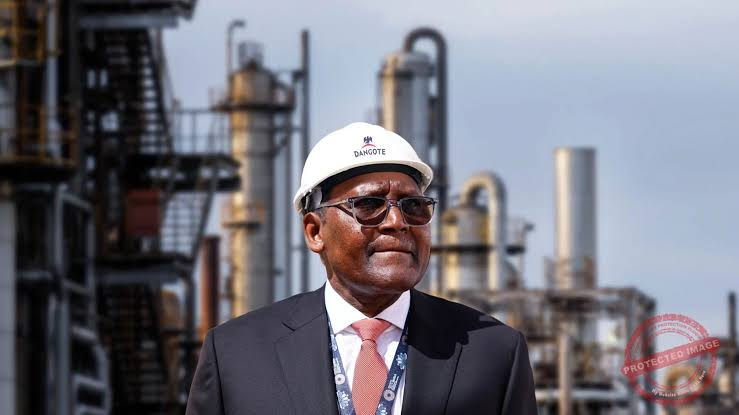
Aliko Dangote, president and chief executive of Dangote Group, has committed an additional $50 billion in investments across Africa by 2030, declaring that the continent must mobilise its own capital, build businesses at global scale and increasingly allow Africans to own the enterprises driving its industrialisation.
Speaking at the Global Africa Business Initiative’s “Unstoppable Africa 2026” gathering in New York on the sidelines of the 81st United Nations General Assembly, Dangote said Africa needs foreign capital but argued that Africans must invest first, develop the continent’s resources and demonstrate the opportunities available to international partners. “We have already invested more than $25 billion, but right now, we’re going ahead to invest an additional $50 billion,” he said. Vision 2030: From $25 Billion to $50 Billion MoreThe new commitment forms the core of Dangote Group’s “Vision 2030” strategy, which aims to transform the conglomerate into a $100 billion enterprise with annual revenues exceeding $115 billion and profits of around $35 billion by the end of the decade. Between 2020 and 2025, the group invested roughly $25 billion in capital expenditure, largely centred on the 650,000-barrel-per-day Dangote Petroleum Refinery and Petrochemicals complex in Lagos, Nigeria, and associated fertiliser and power projects.
Over the next five years, Dangote plans to roughly double that spend, directing between $46 billion and $50 billion into new and expanding operations across refining, petrochemicals, fertiliser, gas, power, pipelines and related infrastructure. Management says internal forecasts show revenues and cash flows from existing assets will fund equity for this capex, while debt commitments have been secured from financiers including the Africa Finance Corporation (AFC).
Key components of the expansion include a proposed 700,000-barrel-per-day greenfield refinery and petrochemical complex in Lamu, Kenya, estimated at about $17 billion, intended to serve East Africa and the wider region, alongside an $8 billion, 13-million-tonnes-per-annum Liquefied Natural Gas (LNG) plant in Nigeria designed to monetise associated gas and expand the group’s gas value chain. The group also plans to deploy more than $10 billion in power sector investments across Africa over the next three to four years, supporting industrial clusters and reducing reliance on unstable grids.
Major pipeline projects form another pillar of the strategy, including the $660 million Damarjog–Dewele oil terminal and pipeline linking Djibouti and Ethiopia, and a planned $3.5 billion, 2,650-kilometre petroleum pipeline to supply landlocked Southern African markets such as Botswana and Zambia. In parallel, Dangote is expanding fertiliser production and has announced plans for an initial public offering (IPO) of its fertiliser business in 2028 to unlock further growth capital. Dangote said these projects are designed to process Africa’s resources locally, create jobs, lower import dependence and build integrated industrial ecosystems around each major complex.
Beyond the numbers, Dangote used the New York platform to issue a broader call to African governments, businesses and investors. He urged the continent to remove trade barriers, deepen regional integration under the African Continental Free Trade Area (AfCFTA), and create policy environments that support large-scale manufacturing and value addition.
“Africa cannot achieve sustainable prosperity without transforming its productive capacity,” he said, arguing that the continent’s growing population and consumer market provide sufficient demand to justify world-scale industrial investments. He stressed that while foreign partners remain important, Africans must lead in financing and owning the industries that will shape their future.
If delivered, the $50 billion programme would represent one of the largest single private-sector capital commitments to African industrialisation in recent decades. It signals confidence in the continent’s long-term growth prospects and reinforces Dangote Group’s ambition to be a pan-African industrial champion rather than a Nigeria-centric conglomerate.
For policymakers, the plan underscores the importance of stable macroeconomic frameworks, predictable regulation, reliable power and transport infrastructure, and access to long-term finance. For investors, it highlights refining, gas, fertiliser, power and cross-border infrastructure as priority sectors where scale, integration and local market access can drive competitive returns.
As Dangote Group moves from announcement to execution, the test will be whether these projects can be delivered on time and within budget, and whether they catalyse wider investment across Africa’s industrial landscape.
Africa Presents is a Pan-African digital magazine and monthly publication covering politics, business, economy, culture, tech, and the stories shaping Africa and its diaspora. Visit africapresents.com and follow @AfricaPresents for daily coverage and monthly themed magazine editions.





Leave a comment