

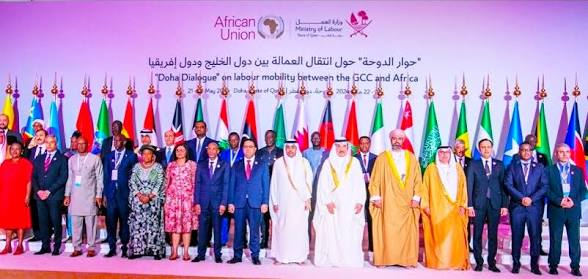
Labour ministers from African Union (AU) member states and Gulf Cooperation Council (GCC) countries, together with Jordan and Lebanon (GCC+), are set to meet in Dar es Salaam, Tanzania, on the 5th–6th of October for the second Africa–GCC+ Dialogue on Labour Mobility, aiming to turn high-level commitments into concrete action on safe, orderly and humane migration.The ministerial dialogue, hosted by Tanzania, comes as governments on both sides manage one of the world’s busiest labour corridors. Officials say origin and destination countries can no longer govern this movement separately if fair and sustainable mobility is to become a reality.
The Dar es Salaam meeting follows the inaugural Africa–GCC+ Labour Migration Dialogue held in Doha in 2024, which produced a declaration outlining shared principles and recommendations. The 2026 dialogue is being held under the theme “From Commitment to Action: Advancing Fair and Sustainable Labour Mobility between Africa and the GCC.”
Organisers say the focus will shift from general principles to practical measures on skills recognition, recruitment standards, worker protection, social security and health coverage, and the portability of benefits across borders. Bilateral labour agreements between African and Gulf states are expected to feature as a cross-cutting issue.
Ahead of the Dar es Salaam summit, African governments, employers’ organisations and trade unions met in Nairobi on the 22nd–23rd of September to consolidate a common African position. The tripartite meeting, convened by the African Union Commission (AUC) with support from the International Labour Organization (ILO), brought together representatives from 28 AU member states, regional economic communities, the AUC, ILO, ITUC-Africa and Business Africa.
Participants worked towards a Common African Tripartite Statement and a set of recommendations to guide negotiations in Dar es Salaam. Key priorities include expanding legal pathways for skilled and semi-skilled workers, strengthening protections against exploitation and abuse, and ensuring that labour migration contributes to development in both sending and receiving countries.
Tanzania’s role as host reflects its growing coordination function on labour migration in East Africa. In August 2026, it took over the chairmanship of the Regional Technical Advisory Committee on Labour Mobility for the East and Horn of Africa from Uganda, and has been active in regional forums linking East African labour markets with Gulf destinations.
The Prime Minister’s Office – Labour, Employment and Relations has been preparing for the dialogue through national technical working groups and public awareness initiatives on fair recruitment and regular migration pathways, including bilateral agreements with Qatar, the United Arab Emirates, Saudi Arabia and other Gulf states.
The Dar es Salaam dialogue is expected to focus on aligning training, certification and skills recognition so that African workers can access decent jobs in the Gulf in sectors with verified labour shortages. Discussions will also address strengthening recruitment regulations, contract enforcement, inspection mechanisms and grievance procedures to reduce exploitation, especially for domestic and low-skilled workers, as well as exploring ways to extend health coverage, pension rights and other social benefits to migrant workers and to make these benefits portable across borders. The process is designed as a voluntary, non-binding, state-led consultative platform, building on existing frameworks such as the Migration Policy Framework for Africa and the Joint Labour Migration Programme.
For African countries, the dialogue offers a chance to negotiate more balanced bilateral labour agreements that protect citizens while unlocking remittance flows and skills acquisition. For GCC+ countries, it provides a structured channel to engage with African governments on workforce planning, reduce irregular migration and improve the governance of labour recruitment.
If the Dar es Salaam meeting produces a clear action plan and follow-up mechanism, it could mark a turning point in how Africa and the Gulf manage one of the world’s most significant South–South labour corridors—moving from ad hoc arrangements to a more predictable, rights-based and development-oriented system.
Africa Presents is a Pan-African digital magazine and monthly publication covering politics, business, economy, culture, tech, and the stories shaping Africa and its diaspora. Visit africapresents.com and follow @AfricaPresents for daily coverage and monthly themed magazine editions.







Leave a comment