

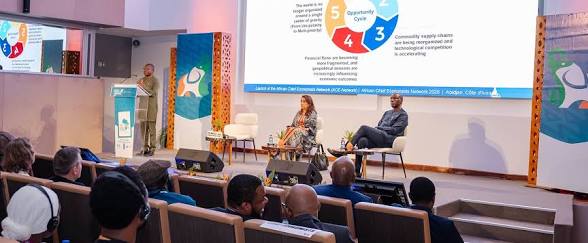
The 2026 African Economic Conference concluded in Abidjan on the 12th of July, bringing together economists, researchers, policymakers, and development experts over three days at the African Development Bank Group headquarters under the theme “Strengthening Africa’s Geopolitical Agency and Trade Resilience in a Multipolar World.” More than 4,000 participants connected virtually across the three days, reflecting growing interest in Africa’s search for stronger, home-grown policy responses to a rapidly changing global environment.
The central message at the conference was clear: African countries must act collectively to shape their own future in an increasingly multipolar world. UN Assistant Secretary-General and UNDP Regional Bureau for Africa Director Ahunna Eziakonwa put it most directly: “The world is being rewritten. Africa’s role is no longer to adapt to rules made by others, but to help define the rules of tomorrow. Geopolitical influence will not be granted to us; it must be earned through stronger institutions, deeper regional integration, resilient trade and the courage to act together.”
One of the principal outcomes of the conference was the launch of the Africa Chief Economists Network, a continental body designed to strengthen Africa’s collective economic intelligence and policy leadership. Raymond Gilpin, Chief Economist at UNDP’s Regional Bureau for Africa, described the network’s purpose: “The Africa Chief Economists Network will be an engine room that designs creative solutions necessary for Africa to attain the Sustainable Development Goals and the African Union’s Agenda 2063.”
After three days of discussions, the AfDB, UNDP, and OECD identified trade integration, local value addition, investment, and stronger public policies as the continent’s best response to growing geopolitical uncertainty. Eziakonwa urged stakeholders to maintain momentum: “The lasting impact of these past days will be determined by what we do next: remove barriers to trade, invest in African enterprise and innovation, strengthen regional value chains, and equip our young people to compete in a changing global economy. In a multipolar world, Africa’s greatest leverage will not come from choosing sides, but from building its own economic strength.”
The Honest Assessment
However, the final result does not include measurable targets or a timetable for implementation. While the closing statement highlights regional integration, coordinated economic policies, regional value chains, better data, and business financing as priorities, it does not specify funding commitments, responsible institutions, or implementation deadlines. The impact of AEC 2026 will therefore be measured through concrete outcomes, including growth in intra-African trade, expanded local processing capacity, greater investment in businesses, and stronger public policies.
The conference emphasised that Africa’s long-term competitiveness will depend on expanding regional value chains, accelerating industrialisation, strengthening domestic capital markets, and improving integrated policymaking across trade, debt, investment, climate action, and development finance. OECD Senior Policy Advisor Ida McDonnell framed the challenge: “Our analytical frameworks must now adapt to the reality and uncertainty in which we live. Trade, debt, investment, fiscal policy, climate action and development finance are becoming increasingly interconnected. Yet we often continue to analyse them separately.”
Participants agreed that Africa possesses major comparative advantages, including the world’s youngest population, abundant renewable energy resources, critical minerals, expanding digital markets and the world’s largest free trade area under the AfCFTA, but that stronger institutions, better policy coordination and higher-quality economic analysis will be essential to convert those assets into sustained growth.
Africa Presents is a Pan-African digital magazine and monthly publication covering politics, business, economy, culture, tech, and the stories shaping Africa and its diaspora. Visit africapresents.com and follow @AfricaPresents for daily coverage and monthly themed magazine editions.







Leave a comment