

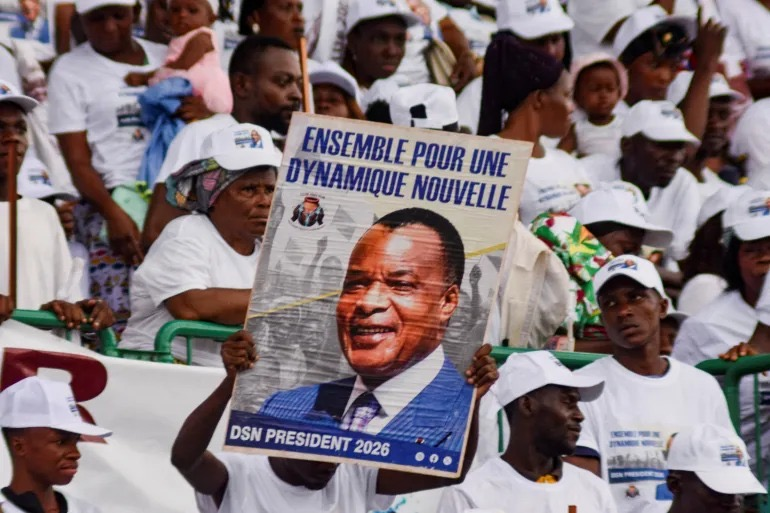
Today, 15 March 2026, citizens of the Democratic Republic of Congo will be heading to the polls in a presidential election that many analysts say is unlikely to change the country’s political direction. This election has drawn attention across Africa not only because of the long tenure of the incumbent but also because it reflects broader questions about democracy, youth participation and political renewal on the continent.
For young Africans watching closely, the election raises a bigger question: what does political change actually look like in countries where power has remained in the same hands for decades?
A Leader Who Has Defined a Political Era
At the centre of the election is Denis Sassou Nguesso, one of Africa’s longest-serving leaders. Now 82 years old, he first came to power in 1979 and, aside from a brief period in the 1990s, has dominated the country’s politics ever since.
He lost the country’s first multiparty election in 1992 but returned to power in 1997 after a civil war. Since then, he has won every presidential contest; 2002, 2009, 2016, 2021 and now seeks another term in 2026.
One turning point came in 2015, when a constitutional referendum removed presidential age and term limits. That decision cleared the path for his continued rule and shaped the political environment leading into today’s election.
Officially, the presidency is elected for five-year terms and a candidate must win an absolute majority of votes to avoid a second round.
Yet critics argue that the structure of power—control of state institutions, media dominance and a weakened opposition, makes genuine competition extremely difficult.
An Election Without Real Competition?
Seven candidates were approved to contest the election, including independent figures and smaller party leaders. However, none are widely seen as serious challengers to the incumbent.
Some of the country’s main opposition groups chose to boycott the vote, claiming the electoral environment is neither free nor fair.
Political space has also narrowed in recent years, with reports of activists arrested and opposition leaders imprisoned or forced into exile.
Even the campaign itself reflected this imbalance. Observers noted that Sassou Nguesso was the only candidate conducting extensive nationwide rallies, reinforcing perceptions that the contest was largely symbolic.
Technically, while the mechanics of democracy are like campaigns, ballots and vote counts are present, the competitive spirit of democracy appears muted.
Internet Shutdowns and Electoral Control
On election day, internet connectivity in the country dropped sharply after authorities cut access nationwide, a move critics say undermines transparency.
This tactic has been used in several African elections in recent years and often sparks debate about the relationship between digital freedoms and democratic participation.
Limiting online access can restrict the spread of misinformation but it can also silence activists, journalists and ordinary citizens trying to report irregularities.
For many young voters, who rely heavily on social media for news and political discussion, the shutdown symbolised a deeper problem: the shrinking space for public debate.
Youth Disillusionment: The Silent Story of the Election
Perhaps the most striking aspect of this election is not who will win but how many people may choose not to vote at all.
Reports suggest that turnout could fall below previous elections, reflecting widespread frustration among young citizens.
This matters because young people make up the majority of the country’s population. Yet many feel excluded from the political system.The result is a growing generation that views politics with scepticism.
Instead of seeing elections as a chance to shape their future, some see them as rituals that legitimise existing power structures.
A Resource-Rich Nation Still Struggling
The Republic of the Congo sits on significant oil reserves, making it one of Central Africa’s energy exporters.
Yet economic inequality remains stark.
More than half of the population lives in poverty, and government debt has climbed to roughly 94.5% of GDP, raising concerns about long-term fiscal stability.
Critics argue that decades of centralised power have slowed economic diversification, leaving the country heavily dependent on oil revenues.
For many young people, the question is simple:
If the country is rich in resources, why does everyday life still feel economically fragile?
Succession Politics: What Happens After Sassou?
Beyond the election itself, analysts are increasingly focused on the question of succession.
There is speculation that the president’s son, Denis‑Christel Sassou Nguesso, may eventually inherit political leadership in the country.
Political dynasties are not uncommon in Africa, but they raise difficult questions about democratic renewal.
Will leadership transitions come through competitive elections, or through elite political networks?
The answer may shape the country’s political trajectory long after the current vote.
The Wider African Context
The Congo election reflects a broader trend across parts of Africa where long-serving leaders continue to dominate political landscapes.
Across the continent, debates about governance increasingly revolve around three tensions:
- Stability vs political change
- Strong leadership vs institutional democracy
- Youth expectations vs ageing political elites
For Africa’s young population projected to become the largest in the world by mid-century these tensions are not abstract political debates. They shape everyday realities: jobs, education, and social mobility.
Why This Election Matters Beyond Congo
Even if the outcome appears predictable, the election still matters for several reasons.
First, it highlights the growing political awakening among African youth, who are increasingly questioning systems that seem resistant to change.
Second, it illustrates the complex relationship between democracy and power in resource-rich states.
Finally, it reminds us that elections alone do not define democracy, participation, transparency, and accountability do.
The Bigger Question for Africa’s Young Generation
As ballots are counted and results begin to emerge, one question lingers:
What does meaningful political change actually look like in Africa’s long-established political systems?
Is it new leaders?
Stronger institutions?
Or entirely new forms of civic participation driven by technology and youth movements?
The answer may not come from this election alone.
But the conversation it sparks across classrooms, newsrooms and youth circles across Africa might shape the continent’s political future far more than the result itself.
We look interestingly ahead to the outcome of DR Congo’s presidential elections.





Leave a comment