

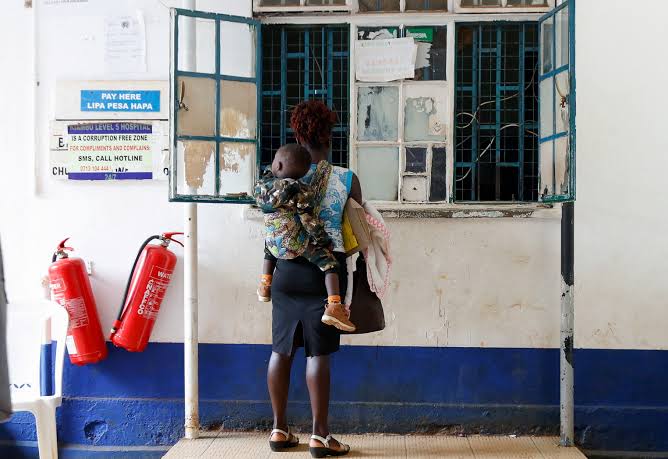
Development assistance for health to Africa has entered a sustained decline, falling from a high of $25.8 billion in 2021 to $19.9 billion in 2022 and further to around $13 billion in 2025, driven largely by sharp reductions in US and European funding. The retreat is not a temporary contraction. A genuine shift occurred in 2025, as cuts in bilateral health aid, led by the abrupt US withdrawal and reinforced by significant policy shifts in the UK, Germany, and France, signal a broader and more permanent erosion of the traditional donor-recipient model.
For a continent that has built much of its health infrastructure on that model over the past two decades, the moment is forcing an uncomfortable but overdue reckoning.
The Scale of the Problem
Africa bears approximately 22 per cent of the global burden of disease, yet accounts for just 1 per cent of global health expenditure. Average health expenditure per capita on the continent remains at $85, with fewer than 40 percent of African countries meeting the WHO-recommended minimum of $86 per capita required to deliver an essential package of health services.
Government sources account for 35 percent of total health expenditure across Africa, external assistance about 23 per cent, and out-of-pocket payments 35 per cent, with reliance on out-of-pocket spending ranging between 40 and 60 per cent in many lower-income countries, exposing households to catastrophic health expenditures and pushing an estimated 15 million people into poverty each year.
WHO Director-General Dr Tedros Adhanom Ghebreyesus has framed the urgency starkly: “Health aid is projected to decline by up to 40 per cent this year compared to just two years ago. This is not a gradual shift, it is a cliff edge. Africa must invest in its own systems. The future of global health security depends on the strength of national systems.”
A move from Charity to Sovereignty
The language emerging from African policy circles has shifted decisively from aid dependency to sovereignty. Serah Makka, Executive Director for Africa at the ONE Campaign, has argued that healthcare financing is not only a social issue but a sovereignty issue for the continent, noting that 30 African countries spend more on debt servicing than on health or education.
Makka has identified health insurance as a key bridge to expand services and reduce costs through pooled procurement, while highlighting debt-for-health swaps as an innovative tool, with Sierra Leone cited as a country exploring the model. She has also pointed to targeted taxes on tobacco, alcohol, and gambling as additional domestic funding sources, while stressing that plugging revenue leakages and improving spending efficiency should be the first source of new capital.
Previous efforts to increase domestic health financing through the African Union’s Abuja Declaration have not succeeded, leaving African countries vulnerable to political shifts in donor nations. The continent now faces what analysts are calling a hinge moment, requiring innovations in macroeconomic and fiscal policy, increased political prioritisation of health, and the scaling of novel financing pathways.
The Capital Is Already on the Continent
What makes the financing conversation different in 2026 is a growing recognition that Africa’s challenge is not a lack of money, but a failure to direct existing capital toward health. The Africa Finance Corporation’s State of Africa’s Infrastructure Report 2026 puts the continent’s total domestic capital base at $4.4 trillion, exceeding the approximately $1.7 trillion in cumulative external flows Africa received between 2014 and 2024. Africa’s non-bank domestic capital pools now exceed what the entire external financing architecture delivered to the continent over the past decade.
The continent holds over $2 trillion in capital managed by institutional investors alone. The question is no longer whether Africa has the money, it is whether Africa has the systems to put that money to work for health. The diaspora connection to health financing is also organic rather than manufactured, in a region where 75 percent of remittances go toward household essentials including healthcare.
The Path Forward
Africa’s health financing crisis is, in the end, a sovereignty test disguised as a budget problem. With the continent’s population set to grow from 1.4 billion in 2025 to 2.5 billion in 2050, and total health spending projected to rise from roughly $110 billion in 2023 to $260 billion by 2050, rapid population growth will significantly dampen the per-capita gains that increased spending might otherwise deliver.
Africa has the capital and it has the institutions. What it doesn’t have is the political will and structural discipline to connect the two. The countries that move first to build that connection, through pooled procurement, debt-for-health swaps, sin taxes, diaspora bonds, and institutional investment in domestic health systems, will be the ones writing Africa’s next chapter in health financing on their own terms, rather than waiting for someone else to write it for them.
Africa Presents is a Pan-African digital magazine and monthly publication covering politics, business, economy, culture, tech, and the stories shaping Africa and its diaspora. Visit africapresents.com and follow @AfricaPresents for daily coverage and monthly themed magazine editions.







Leave a comment